
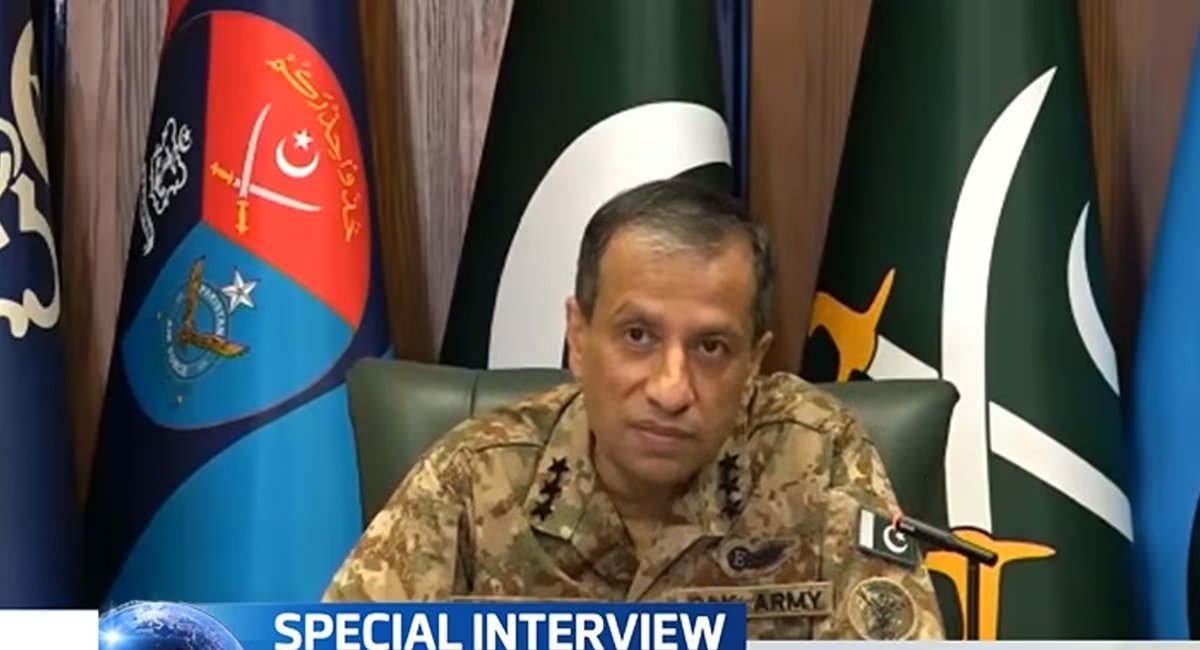
RAWALPINDI: Director General Inter-Services Public Relations (DG-ISPR) Lieutenant General Ahmed Sharif Chaudhry on Wednesday rejected the impression that the Mecca Joint Defence Agreement complicates Pakistan’s position towards Iran, saying the agreement has no regional aspirations and is purely defensive in nature.
In an interview with Al Arabiya English, the DG-ISPR said Pakistan was playing an important role as a mediator between Iran and Washington in pursuit of regional peace, as Islamabad remained a strong proponent of peace.
He said Pakistan had the unique position of pursuing a policy of “multi-alignment and multi-engagement” with friendly countries around the world, allowing it to act as an objective arbiter for peace.
“We don’t have any personal or own objective in this dispute,” he said.
“The only objective that Pakistan is pursuing is that the conflict doesn’t spiral and that the differences and issues are resolved rather than being resolved in air, ground or naval domains,” he added.
Responding to a question about the broader conflict spilling over towards Pakistan’s western border, Lieutenant General Ahmed Sharif said Pakistan was confident in its ability to protect its territorial integrity and sovereignty.
“As far as our own borders, our own territorial integrity or sovereignty is concerned, we are very confident and very self-reliant on our security,” he said.
He acknowledged that concerns over any conflict spiralling “horizontally or vertically” remained, adding that Pakistan, the region and the wider world were feeling the impact of the conflict.
“Pakistan is fully confident of taking care of whatever nefarious designs come out of that towards Pakistan,” he said.
The DG-ISPR said Pakistan’s relationship with any country was not maintained at the expense of its ties with another.
“Our relationship with the United States is independent and it is not at the cost of Iran. It is not at the cost of China. It is not at the cost of any other country,” he said.
“We have independent relations with multiple countries, multiple poles, multiple powers in this world. And all these relations are based on merit and mutual benefit,” he added.
He said Pakistan had its own national purpose, priorities and national-interest objectives focused on the prosperity and stability of its people.
“Every country is entitled to do that,” he said.
Rejecting the suggestion that the Mecca Joint Defence Agreement could complicate Pakistan’s position towards Iran, the DG-ISPR said the military partnership among Pakistan, Saudi Arabia and Türkiye had not emerged suddenly but was based on decades-old strategic relations.
He described the agreement as a formalisation of those strategic relationships in a peculiar environment, stressing that it was based on collective deterrence.
“It has got no offensive, no interference, no aggressive element. Not at all. And it is purely defensive in nature,” he said.
According to the DG-ISPR, the agreement formalises Pakistan’s decades-old relationship with Saudi Arabia and Türkiye in the domains of collective deterrence and defence.
“There are no regional aspirations,” he said.
He added that the mutual defence agreement was “complementary in nature” and did not compete with Pakistan’s other relationships, noting that all three countries maintained independent relations with other alliances and countries.
Responding to a question about how Pakistan would respond if one of the partners came under attack, Lieutenant General Ahmed Sharif said the operationalisation of the defensive commitment was part of the agreement’s operational and security arrangements.
“How it will be done is for the three countries to decide. It is for them to know and for them to actualise it,” he added.

Comments
Comments (0)
Security Check
Please complete the captcha to verify you are human.