
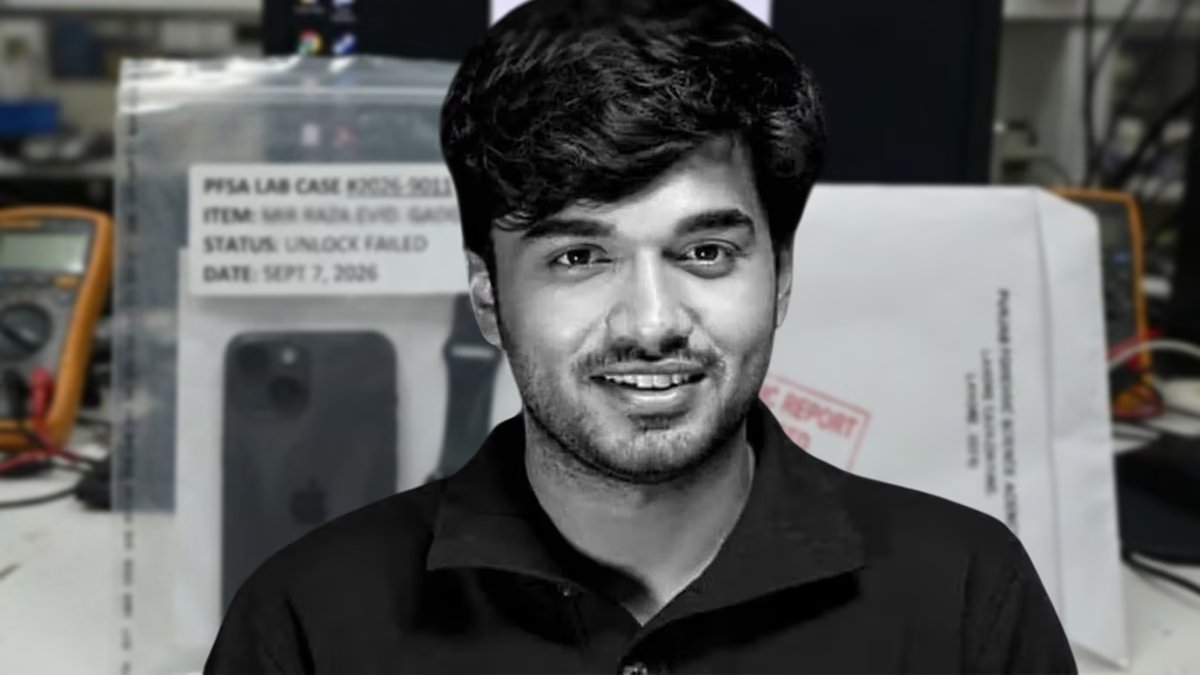
In the Mir Raza Ali case, the young businessman of Karachi, Police Surgeon Dr Summaiya Sayed Tariq appeared before the judicial Inquiry commission and recorded he statement in the death of Mir Raza and gave detailed evidence about the exhumation, second post-mortem, and forensic findings.
Dr Syed, while recording her statement, told the commission that she had raised concerns about the case with the Senior Superintendent of police (SSP) East, Zubair Nazeer Sheikh, on 2 August 2026, and recommended an exhumation in a letter dated 3 August 2026. A second letter was sent on 5 August seeking an exhumation and a fresh post-mortem.
She replied to the commission and said medical boards are generally constituted based on doctors’ expertise and experience. The court can direct the health secretary, director general of health services, or police surgeon to constitute such a board. She claimed that most experienced medical experts were part of the medical board in Mir’s case.
Medical Board controversy:
According to Dr Summaiya, the original medical board was later changed, with all members except her being replaced. She said she did not know the reason for the change and that a deputy secretary for health had verbally told her that she should withdraw from the board.
On the day the exhumation was due to take place, Additional Inspector General Police (AIGP) Azad Khan sent an order from the Director General of Health Services; under the order, it was allowed to include any member in the team, Dr Summaiya said.
Following a call from the additional IG, members of the previous team were also summoned for the exhumation, she said. However, the judicial magistrate later cancelled the exhumation proceedings, according to Dr Summaiya.
The health secretary subsequently reinstated the previous medical board, she said.
Dr Sumayya said the deputy health secretary had verbally instructed her that she should withdraw from the medical board.
“I told them that my name was included in the judicial magistrate’s order,” she said.
Exhumation, Injuries and forensic findings:
The police surgeon, Dr Syed, told the commission that only members of the previous team were present during the exhumation proceedings on 8 August 2026.
“We did not allow any unrelated person to enter,” she said.
She said the exhumation process was ultimately carried out on 8 August 2026 by the original team. The judicial magistrate had initially cancelled the exhumation, she said, before the health secretary restored the original medical board.
The police surgeon told the commission that Mir Raza had an injury to his head, a broken nasal bone and an injury to the back of his head consistent with impact from a hard object. She said the injury appeared to have occurred during his lifetime.
She also disputed aspects of the initial post-mortem report, saying the size of the gunshot wound had been incorrectly recorded and that the wound identified on the chest as the bullet entry point was wrong.
She said the bullet had fractured Raza’s ribs and damaged his lung and heart. The final post-mortem report, she added, had been signed by all members of the medical board.
Dr Syed said no gunshot residue samples had been collected during the initial post-mortem. She said the second post-mortem involved 263 photographs, which were examined in detail after a dispute arose over the location of the gunshot wound.
She also said the initial post-mortem’s description of damage to the hands as decomposition was incorrect. According to her, there were chemical burns on Raza’s hands and feet.
Acid and chemical evidence
Dr Syed said signs of chemical burns were found on Raza’s body and that a chemical examination confirmed the presence of acid.
She said hydrochloric acid can cause polyester fabric to carbonize and that carbonization was found on Raza’s shirt. The chemical examination also detected hydrochloric acid residues and gunshot residue on the shirt.
She told the commission that decomposition did not adequately explain the pattern of injuries. Four dermatology experts had been consulted, she said.
The commission questioned why police had apparently not taken account of the photographs and other findings.
Dr Samia said the lack of blood at the crime scene was also significant. The human body normally contains around five to six litres of blood, she said, and a major heart injury would ordinarily be expected to produce substantial bleeding.
Anaesthetic detected
Dr Summaiya also addressed the presence of a local anaesthetic in the forensic findings. She also admitted that this was the first time in her career she had witnessed a case of chemical torture
She said the forensic report established that anaesthetic was present in Raza’s blood, meaning it was in his body when he was shot. However, she said the testing could not establish the precise quantity.
She disputed the half-life information provided by Dr Osama, saying local anaesthetic can take between two and nine hours to wear off, depending on the circumstances. If administered directly into a vein in a large enough quantity, she said, it could have fatal effects.
Asked whether anaesthetic could be administered through a spray, Dr Syed said such administration might leave no detectable trace. The commission noted that there had been cases in which substances sprayed on people’s faces had left them unconscious for some time.
The commission also said anaesthetic should not be easily available without a prescription. Dr Summaiya agreed that this would not normally be the case.
Suicide ruled out
The commission questioned whether the exhumation had been ordered specifically to determine whether Raza had died by suicide.
Dr Syed said the medical board had ruled out suicide because its findings were not consistent with that explanation. She said the board’s task was to examine the questions and concerns raised about the case.
She also confirmed that the health secretary was her administrative superior.
Claims of threats:
During the hearing, Dr Summaiya said she had put her career and employment at risk by pursuing the case.
She alleged that she had been followed on a motorcycle for two days and had received threats. She said she had been told that if she recorded the death as suicide, she would be treated more leniently.
Dr Syed said a campaign against her was also being conducted publicly and that she had filed a complaint with the National Cyber Crime Investigation Agency (NCCIA).
The commission asked whether she required security. Justice Omar Sial offered Ranger’s security, but Dr Syed said she did not want protection for herself. She said her concern was for her family and that her husband’s name and the name of her home had been shared on social media.
The commission directed that letters be sent to the Sindh chief minister and the interior minister regarding the situation.
Dr Syed also clarified comments attributed to Dr Osama that had circulated online. According to Dr Samia, she wanted to make it clear through the commission’s platform that she had never said she had “trapped” Dr Osama or that she would be the person to get him out of the situation.
Comments
Comments (0)
Security Check
Please complete the captcha to verify you are human.