
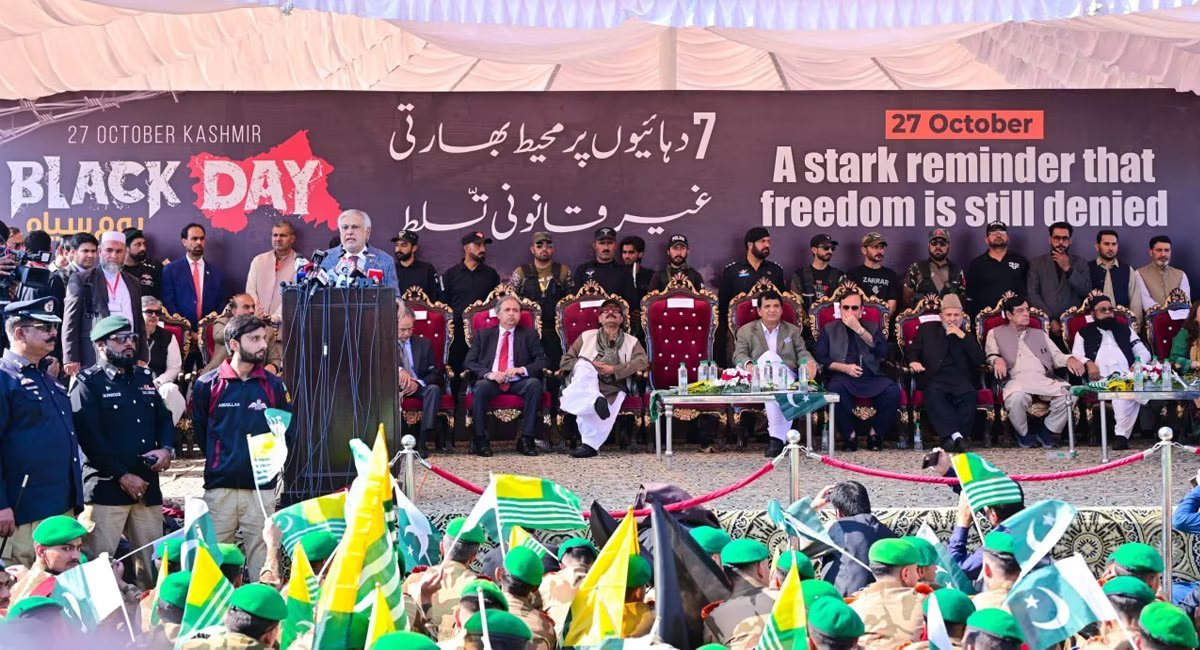
ISLAMABAD: Deputy Prime Minister and Foreign Minister Ishaq Dar on Tuesday reaffirmed Pakistan’s commitment to providing moral, political and diplomatic support to the people of Jammu and Kashmir until they achieve their right to self-determination.
Addressing a solidarity walk held in Islamabad to mark Kashmir Black Day, Dar condemned India’s deployment of troops in Srinagar on October 27, 1947, describing it as the beginning of an occupation that, according to Pakistan, violated international law and United Nations Security Council (UNSC) resolutions.
Kashmir Black Day is observed annually by Pakistan and Kashmiris worldwide to mark the arrival of Indian troops in Srinagar in 1947.
The solidarity walk began at the Foreign Office on Constitution Avenue and concluded at D-Chowk. Federal ministers, parliamentarians, leaders of the All Parties Hurriyat Conference, civil society activists and students from educational institutions across the federal capital participated in the event.
Highlighting the government’s diplomatic efforts, Dar said the government, under Prime Minister Shehbaz Sharif, had renewed its efforts to raise the Kashmir issue on international platforms.
He also condemned India’s unilateral actions of August 5, 2019, which revoked the special status of Indian-administered Jammu and Kashmir, describing the move as a violation of international law, UNSC resolutions and India’s constitutional commitments.
Dar said that India was attempting to change the demographic composition of the disputed territory by reducing the proportion of its Muslim population and allowing non-local residents to acquire property.
Pakistan summons US Chargé d’Affaires over diplomat’s Kashmir remarks
Paying tribute to the Kashmiri people, he honoured those who had lost their lives in the struggle for freedom, citing more than 90,000 martyrs.
He also condemned the serious human rights violations, including the detention of political leaders, restrictions on religious practices and Friday prayers, and limitations on access for foreign observers and international media in Kashmir.
Referring to Quaid-i-Azam Mohammad Ali Jinnah’s description of Kashmir as Pakistan’s “jugular vein,” Dar expressed confidence that the sacrifices of the Kashmiri people would ultimately lead to the fulfilment of their aspirations.
He reiterated Pakistan’s position that the Kashmir dispute should be resolved in accordance with relevant UN Security Council resolutions and the right of the Kashmiri people to self-determination.
Comments
Comments (0)
Security Check
Please complete the captcha to verify you are human.