
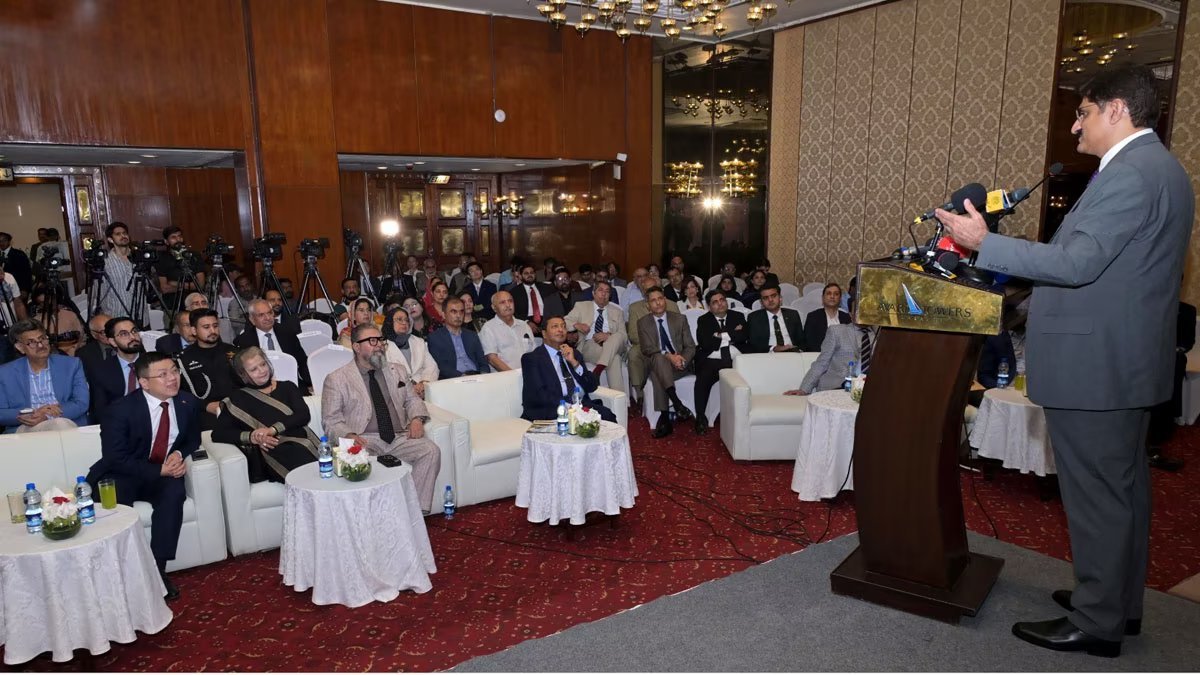
KARACHI: Sindh Chief Minister Syed Murad Ali Shah has proposed introducing a pilot project in one district of Karachi based on Wuhan’s integrated city management system.
Addressing a seminar titled “Understanding China’s Governance & Deepening China-Pakistan Cooperation,” organised by the Karachi Council on Foreign Relations (KCFR) at a local hotel, the chief minister said China’s experience in long-term planning, interdepartmental coordination and poverty alleviation offered valuable lessons for Sindh.
The seminar was attended by Acting Chinese Consul General Dr Feng Deheng, KCFR Chairperson Nadira Panjwani, diplomats, government officials and representatives from various sectors.
Marking the 75th anniversary of diplomatic relations between Pakistan and China, Mr Shah said his recent visit to Hubei and Shanghai had provided valuable insights into how China’s governance framework translated policy decisions into tangible improvements in people’s lives.
He identified three key elements of China’s development experience: continuity in policymaking, effective coordination among government departments and a results-oriented approach focused on improving public welfare.
Referring to his visit to Wuhan’s City Operation and Management Centre, the chief minister said the city’s integrated governance system brought different government departments onto a common platform, enabling authorities to monitor urban challenges, identify emerging risks and respond promptly to public complaints.
He proposed introducing a similar mechanism in one district of Karachi as a pilot initiative, initially focusing on routine urban challenges, including waterlogging, flooded roads and other municipal service-related issues.
Under the proposed system, clear responsibilities would be assigned for registering public complaints, coordinating the relevant departments and ensuring timely resolution.
He suggested that Chinese municipal experts, Pakistani government officials, engineers and academic institutions collaborate on developing the framework and providing technical training to local teams.
The pilot project’s performance, he said, would be assessed through measurable improvements in response times and public service delivery before considering its expansion to other parts of Karachi.
The chief minister called for sustained cooperation between Karachi and Shanghai, which have maintained sister-city relations since 1984.
He proposed expanding collaboration between municipal authorities to address shared urban challenges, particularly water management and public transport.
He also highlighted opportunities for academic and research partnerships, including teacher-training programmes with Central China Normal University and agricultural research cooperation in hybrid rice, seed production and modern farming techniques.
Mr Shah said the proposed Joint Cooperation Council between Sindh and Hubei could provide a structured institutional platform for advancing these areas of collaboration and ensuring continuity in bilateral initiatives.
KCFR Chairperson Nadira Panjwani, in her proposed remarks, underscored the importance of understanding China’s governance experience and translating the longstanding friendship between Pakistan and China into practical and mutually beneficial cooperation.
She further emphasised the need to move beyond conventional diplomatic engagement by strengthening institutional, academic, business and people-to-people connections.
“We must move beyond diplomatic engagement and strengthen connections between our institutions, universities, businesses and people to create lasting opportunities for both countries,” she added.
Acting Chinese Consul General Dr Feng Deheng highlighted China’s achievements in economic growth, poverty reduction, technological advancement and social development.
He said China had lifted more than 700 million people out of poverty over four decades of reform and opening up, accounting for more than 70 per cent of global poverty reduction.
He noted that China’s development model combined scientific planning with effective implementation, policy continuity with institutional coordination, and government initiatives with public participation.
Dr Feng said China respected Pakistan’s independent choice of development path and remained committed to sharing development opportunities and governance experience.
Referring to the 75th anniversary of diplomatic relations between the two countries, he called for stronger comprehensive cooperation, expanded people-to-people exchanges and the high-quality development of CPEC 2.0.
Comments
Comments (0)
Security Check
Please complete the captcha to verify you are human.