
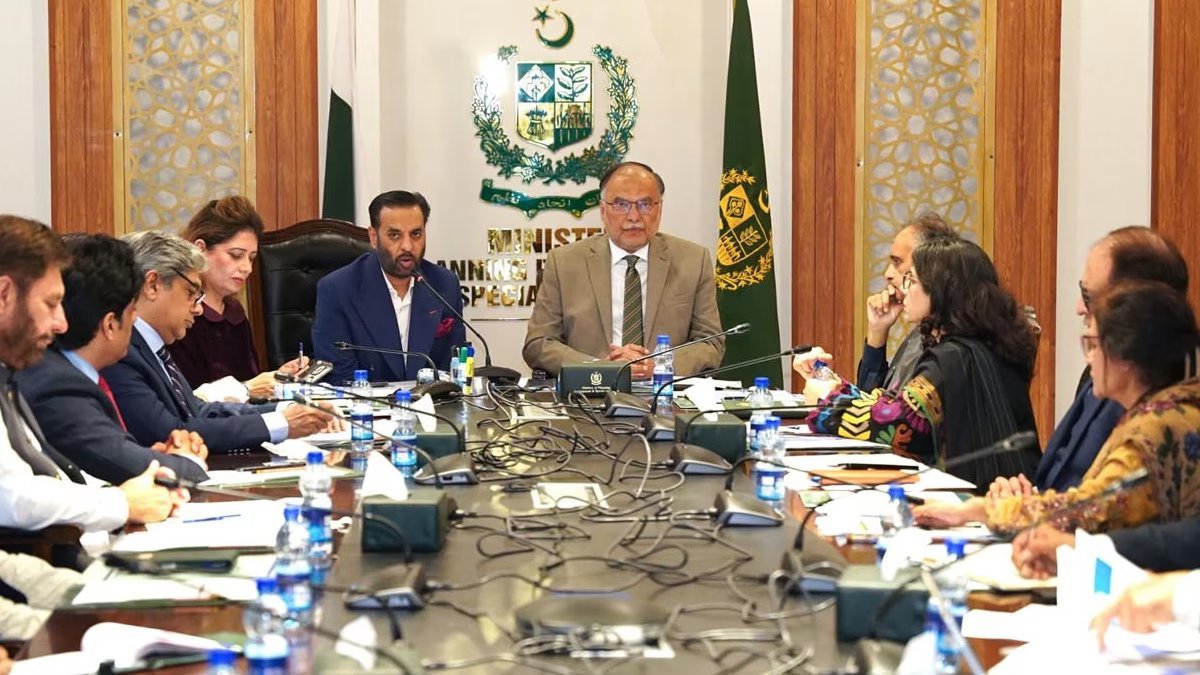
Islamabad – November 12, 2026: The first meeting of the Executive Committee of the National Population Council (NPC) was held on 12th November, 2026, at the Planning Commission, Islamabad, to drive the implementation of interventions and agendas that advance population planning and development, both by stabilizing population growth and by capitalizing on Pakistan’s demographic potential.
The meeting was chaired by the Federal Minister for Planning, Development and Special Initiatives Ahsan Iqbal, and co-chaired by the Federal Minister for National Health Services, Regulations and Coordination, Syed Mustafa Kamal. It brought together federal ministers and secretaries, provincial and regional ministers, and senior officials of the Planning and Development, Health and Population Welfare Departments of all provinces, Azad Jammu & Kashmir and Gilgit-Baltistan.
Addressing the meeting, Federal Minister for Planning, Development and Special Initiatives Ahsan Iqbal said that Pakistan’s rapidly growing population had become a national emergency requiring urgent and coordinated action. He noted that while the population growth rate had gradually declined to 2.4 per cent since 1980, it had risen again to 2.55 per cent in the 2023 Census, describing the reversal as a matter of serious concern. “We have taken our foot off the brake and put it on the accelerator. This trend must be reversed,” he remarked. He emphasized that population figures were not merely statistics but were directly linked to Pakistan’s future, the well-being of its children and the sustainability of national resources. He said that without balancing population growth with available resources, sustainable development and economic prosperity would remain difficult to achieve. Explaining the economic implications, he observed that if the economy grew by 5 per cent while the population increased by 2.5 per cent, the actual growth per capita would be reduced to just 2.5 per cent.
Ahsan Iqbal stressed that unchecked population growth would make it increasingly difficult to meet the country’s growing needs for education, healthcare, employment and basic facilities. He highlighted that the existing NFC Award formula, which assigns 82 per cent weightage to population in resource distribution, created a contradiction by potentially encouraging population growth. He called for linking the NFC Award with development and sustainability indicators to encourage provinces that successfully maintain a balanced population. The Minister further emphasized that population management was not merely a matter of healthcare or family planning but was also closely linked to girls’ education, women’s economic empowerment and social awareness. He called upon federal and provincial governments to adopt a coordinated national strategy, with joint efforts in healthcare, education, community awareness and changing social attitudes, stressing that controlling population growth was essential for Pakistan’s economic security, development goals and the future of coming generations.
The Committee considered the draft National Health and Population Policy and the National Population Stabilization Program presented by the Ministry of National Health Services, Regulations and Coordination. Provinces and regions were requested to notify Provincial Population Councils and Executive Committees, prepare costed implementation plans in line with the Program, and link missing data streams with the Contraceptive Logistics Management Information System so that the country has a complete view of its contraceptive supply chain. The importance of a unified national narrative, and the role of the information ministries in shaping it, was highlighted as vital to carrying forward the work of the Council.
The Executive Committee was constituted by the Prime Minister to translate the policies of the National Population Council into actionable targets and to drive implementation with the provinces and regions. Today’s meeting followed the preliminary meeting of the Council held on 30 October 2026 under the chairmanship of Prime Minister Muhammad Shehbaz Sharif. The Committee will meet regularly to review progress against agreed indicators, with the Ministry of Planning, Development and Special Initiatives serving as its Secretariat.


Comments
Comments (0)
Security Check
Please complete the captcha to verify you are human.