
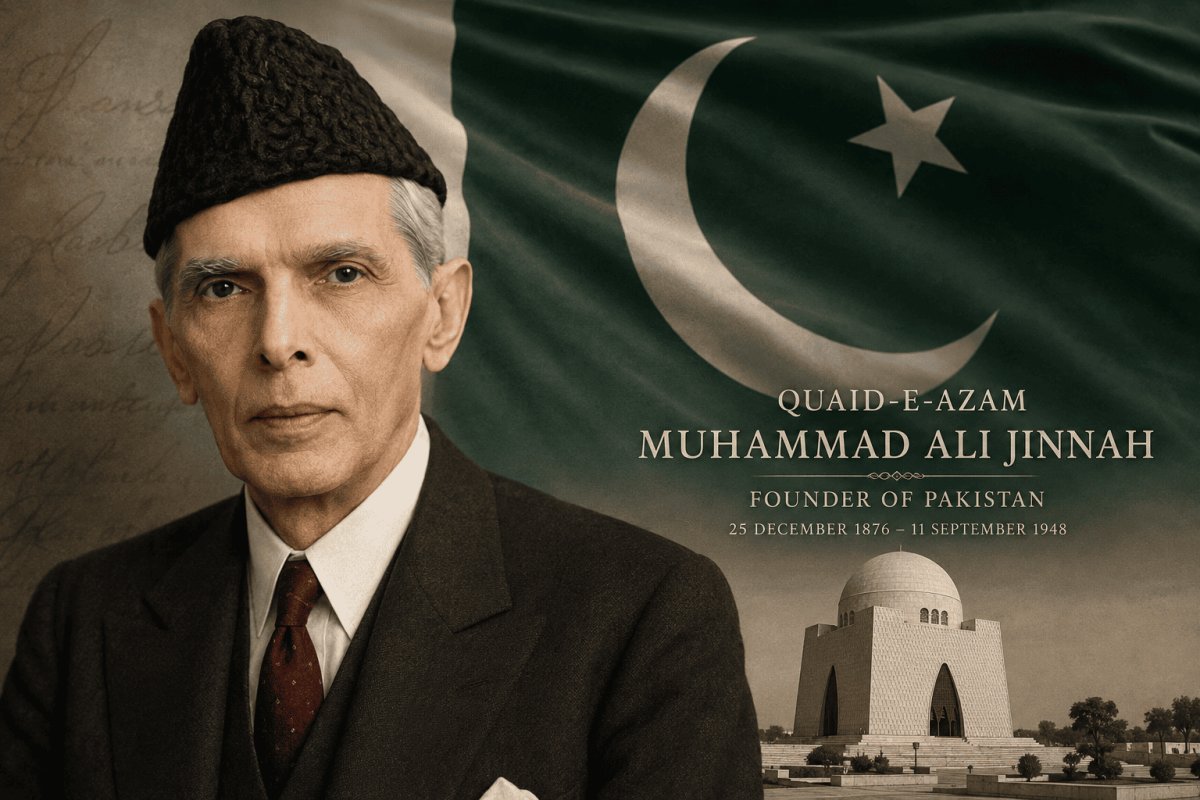
Muhammad Ali Jinnah is one of the most important figures in the history of Pakistan. Known as Quaid-e-Azam, meaning “Great Leader,” he played a central role in the struggle for a separate homeland for the Muslims of the Indian subcontinent. Through his determination, political wisdom, and strong leadership, Jinnah led the movement that eventually resulted in the creation of Pakistan on 14 August 1947.
Even decades after his death, Muhammad Ali Jinnah remains a respected national figure. His speeches, political ideas, and famous principles continue to influence discussions about Pakistan and its future.
Early Life of Muhammad Ali Jinnah
Muhammad Ali Jinnah was born on 25 December 1876 in Karachi, which was then part of British India. He belonged to a merchant family and received his early education in Karachi.
As a young man, Jinnah travelled to England to study law. He became a barrister and developed an interest in politics while building a successful legal career. His experience as a lawyer later became an important part of his political life because he was known for presenting his arguments with confidence, discipline, and clarity.
Muhammad Ali Jinnah and His Political Career
Jinnah entered politics during a period when the future of the Indian subcontinent was becoming increasingly uncertain. He initially worked for cooperation between different religious communities and was associated with the Indian National Congress.
However, over time, Jinnah became increasingly concerned about the political and constitutional rights of Muslims. He believed that Muslims needed effective political safeguards to protect their identity, interests, and representation.
His political journey eventually brought him to the leadership of the All-India Muslim League. Under his leadership, the Muslim League became a major political force representing the demand for Muslim political rights.
The Pakistan Movement
The Pakistan Movement was one of the defining chapters of Muhammad Ali Jinnah's life. As political tensions between different communities increased, the demand for a separate Muslim homeland gained momentum.
The Lahore Resolution of 1940 became a major milestone in this movement. Jinnah and the Muslim League continued to campaign for a political solution that would protect the interests of Muslims in the subcontinent.
Jinnah's leadership during these difficult years required patience and determination. Negotiations, political disagreements, elections, and constitutional discussions continued for years. Despite many obstacles, he remained committed to his political objectives.
Finally, the British decision to divide British India led to the creation of two independent countries, India and Pakistan, in August 1947.
Muhammad Ali Jinnah as the Founder of Pakistan
On 14 August 1947, Pakistan became an independent country, and Muhammad Ali Jinnah became its first Governor-General.
The creation of Pakistan was the result of years of political struggle. Jinnah faced enormous challenges immediately after independence, including the movement of millions of refugees, economic difficulties, administrative problems, and the need to establish new government institutions.
Despite these difficulties, he focused on building a functioning state. He encouraged people to work together, respect the law, and contribute to the development of the new country.
Quaid-e-Azam's Vision for Pakistan
Muhammad Ali Jinnah wanted Pakistan to become a country where citizens could live with dignity and where the rule of law was respected. In his speeches, he often emphasized equality, unity, discipline, and responsibility.
His famous message of “Unity, Faith and Discipline” remains closely associated with his vision for the country.
Jinnah also spoke about the importance of religious freedom and equal citizenship. His 11 August 1947 speech is particularly well known for discussing the rights of citizens and the role of the state in protecting them.
His vision continues to be discussed because Pakistan still faces many of the challenges that Jinnah addressed during the early days of independence.
Leadership and Personality
One of the most remarkable qualities of Muhammad Ali Jinnah was his determination. He was known for his disciplined lifestyle, professional appearance, and ability to remain focused during difficult negotiations.
Jinnah was not known as a loud or emotional politician. Instead, he often relied on legal reasoning, careful arguments, and constitutional methods. His approach earned him both supporters and opponents, but his ability to remain committed to his political goals made him a powerful leader.
For many Pakistanis, his journey represents the importance of patience, courage, and perseverance.
Muhammad Ali Jinnah's Death
Muhammad Ali Jinnah's health declined after the creation of Pakistan. He continued working despite his illness and the enormous responsibilities facing the new country.
He died on 11 September 1948 in Karachi at the age of 71.
His death was a major loss for Pakistan, which was still in the early stages of building its institutions. He was laid to rest in Karachi, where the Mazar-e-Quaid now stands as one of the country's most recognizable landmarks.
Why Muhammad Ali Jinnah Is Still Remembered
Muhammad Ali Jinnah is remembered not simply because he founded Pakistan, but because of the leadership he demonstrated during one of the most complicated periods in South Asian history.
His life offers lessons about determination, political leadership, constitutional struggle, and public service. His famous speeches and principles continue to be studied by students, historians, and political scholars.
For Pakistanis, Quaid-e-Azam remains a symbol of the country's independence and the struggle that made the creation of Pakistan possible.
Conclusion
Muhammad Ali Jinnah's life was closely connected with the struggle for political rights and the creation of Pakistan. From his early career as a lawyer to his role as the leader of the Pakistan Movement, he spent decades working toward his political vision.
Pakistan faced enormous challenges from the moment it became independent, but Jinnah remained focused on creating a strong and organized state. Although he passed away only a year after independence, his influence on Pakistan's history remains significant.
Today, Muhammad Ali Jinnah continues to be remembered as the Founder of Pakistan and Quaid-e-Azam, and his message of unity, faith, and discipline remains an important part of the country's national identity.



Comments
Comments (0)
Security Check
Please complete the captcha to verify you are human.