
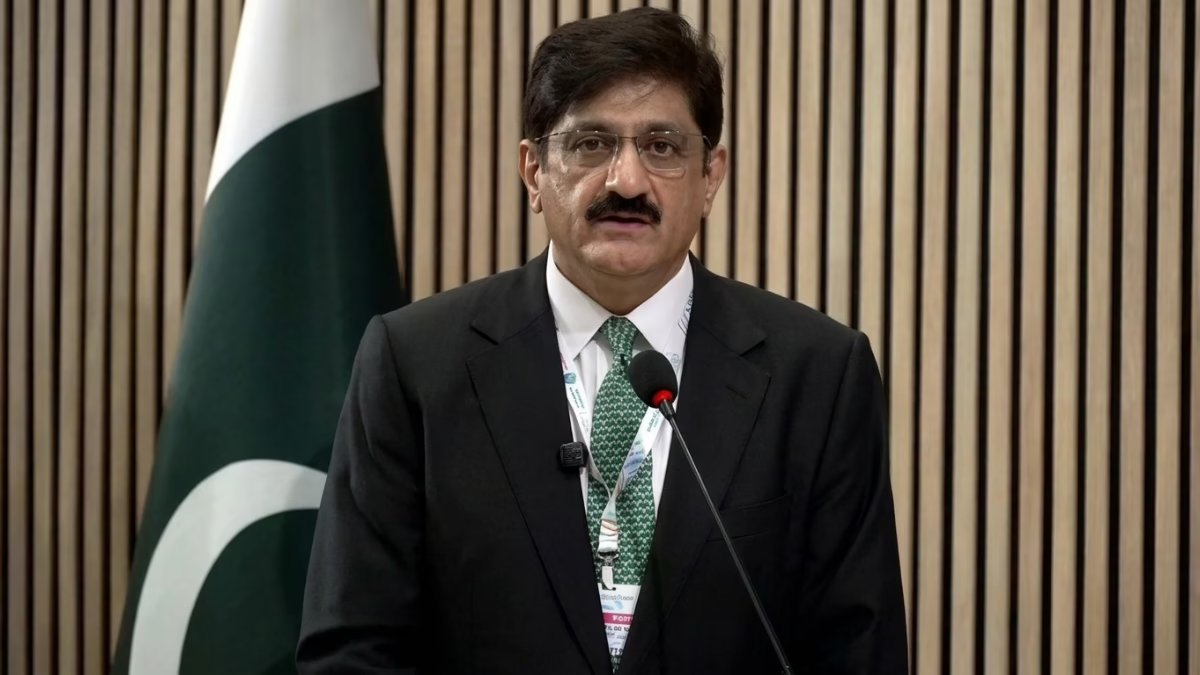
ANTALYA, TURKEY – At the 31st United Nations Climate Change Conference (COP31), Sindh Chief Minister Syed Murad Ali Shah presented the province’s all-encompassing climate resilience strategy, emphasizing doable projects in disaster recovery, climate-resilient housing, water conservation, renewable energy, environmental protection, and sustainable development.
Speaking at the international conference in Antalya, Turkey, the chief minister emphasized that developing nations were bearing the brunt of climate change even though they contributed the least to global emissions. He called for greater international cooperation, equitable climate finance, and technology transfer.
He remarked, saying, “Pakistan contributes less than one per cent to global carbon dioxide emissions but faces devastating floods, extreme heat, droughts and coastal threats. Climate change is not merely an environmental challenge; it is a direct threat to human lives, livelihoods and homes.”
In reference to the catastrophic floods of 2022, Murad Ali Shah stated that 33 million people in Pakistan were impacted, over 1,700 people died, and more than $30 billion was lost economically. Nearly 70% of the damage was done in Sindh alone.
He said the provincial government had adopted a strategy of rebuilding stronger and safer communities rather than merely repairing damaged infrastructure.
One million climate-resilient houses completed
Highlighting the Sindh Peoples Housing Programme, the chief minister said the province had set a target of constructing 2.1 million climate-resilient houses for flood-affected families, making it the world’s largest post-disaster housing reconstruction initiative.
He said one million houses had been completed within three and a half years, while another 700,000 were at different stages of construction. More than 42,000 community committees had been established, and over 1.7 million bank accounts had been opened for beneficiaries. Financial assistance was transferred directly to families, enabling them to construct their own houses. Women had been given a central role through property ownership and financial empowerment.
Mr Shah recalled that World Bank President Mr Ajay Banga had appreciated the programme’s scale, direct banking mechanism and community participation during his visit to Larkana.
Flood protection and infrastructure rehabilitation
Murad Ali Shah said Sindh had reconstructed 205 kilometres of protective embankments, restored 157,000 hectares of agricultural land and strengthened the Manchar Lake protection system, increasing its floodwater discharge capacity to 83,500 cusecs.
He said all 44 gates of Sukkur Barrage had been replaced, while reconstruction of 54 out of 65 gates at Guddu Barrage had been completed. The government aimed to complete the barrage rehabilitation and modernisation programme by 2027.
He added that drainage systems and natural waterways were also being restored to ensure timely disposal of floodwater and protect communities and agricultural land.
The government was simultaneously rebuilding 5,811 flood-affected schools, rehabilitating 141 roads covering 825 kilometres across 19 districts and restoring more than 1,000 damaged health facilities, with particular attention to maternal and child healthcare.
Mangrove restoration and environmental protection
Highlighting nature-based climate solutions, the chief minister said Sindh had restored mangrove forests over 126,000 hectares in the Indus Delta, with a target of expanding the area to 225,000 hectares by 2030.
Under the Delta Blue Carbon initiative, an estimated 142 million tonnes of carbon dioxide emissions were expected to be absorbed or reduced, while 5.6 million tonnes of carbon credits had been verified.
He said mangroves were essential for protecting coastal communities against erosion and cyclones, preserving marine biodiversity and supporting local livelihoods. He also stressed the importance of ensuring continuous freshwater flows from the Indus River to protect the ecological balance of the Indus Delta.
Water security and renewable energy
The chief minister said water conservation was a key priority, with canal lining projects, including the Kalri Baghar Feeder, aimed at reducing water losses and improving supplies to Karachi. Small dams and additional water storage facilities were also being planned for drought-prone areas, particularly Thar.
He said Sindh was leading Pakistan’s renewable energy transition, generating all the country’s wind power. Wind and solar projects in the province had reduced carbon dioxide emissions by approximately 2.67 million tonnes annually.
Sindh generated around 32 per cent of the country’s total electricity, while 36 institutions were producing wind power along its coastal belt and another 34 projects were under development.
The government also planned to provide solar energy to 275,000 low-income households and promote clean energy through agricultural and livestock waste.
On carbon financing, he highlighted the proposed $20 million carbon agreement involving methane gas recovery from Karachi’s Jam Chakro landfill site, with carbon credits to be transferred under Article 6.2 of the Paris Agreement.
Clean water, sustainable cities and climate-smart agriculture
Murad Ali Shah said the first phase of Karachi’s Haroonabad Wastewater Treatment Plant had been completed with a capacity of 35 million gallons daily, which was planned to increase to 100 million gallons by early 2027. Treated wastewater would be reused for industrial purposes, reducing marine pollution and conserving freshwater.
He also highlighted the expansion of electric public transport and plans to promote electric taxis to reduce urban pollution and dependence on petroleum products.
The chief minister said the provincial government was implementing the $540 million STARS-WASH programme across all 22 flood-affected districts to improve drinking water and sanitation facilities. Its first phase would benefit 1.2 to 1.5 million people, particularly in areas affected by child malnutrition and stunting.
He further presented seven investment-ready agricultural projects worth $154.85 million, focusing on climate-smart farming, digital advisory services, solar-powered irrigation and groundwater recharge.
Call for global climate justice
In his closing remarks, Murad Ali Shah invited international development partners and investors to support Sindh through climate finance, modern technology, and investment in clean energy, water conservation, and climate-resilient infrastructure.
According to him, vulnerable people must not be left to bear the consequences of climate disasters, which are becoming more and more of a worldwide concern.
He stated, “The suffering of families affected by natural disasters is the suffering of all humanity. Building a safer and sustainable future for our coming generations is our collective responsibility.”
He recalled Sindh’s five-thousand-year-old civilization along the Indus River and stated that the province was dedicated to preserving the environment and educating the world about its experiences.
He called on international leaders to turn common experiences into coordinated action, making climate justice, safeguarding vulnerable communities, and ensuring children have a safe future top goals.


Comments
Comments (0)
Security Check
Please complete the captcha to verify you are human.