
Introduction
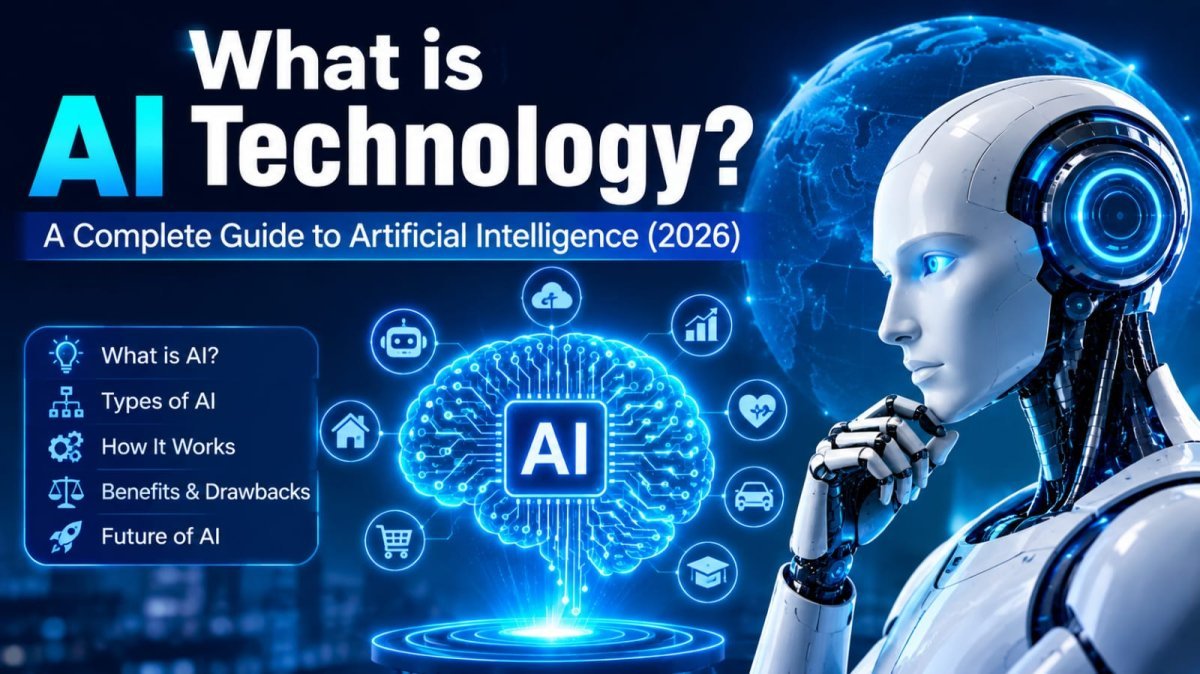
Artificial Intelligence (AI) has become one of the fastest-growing technologies of the digital era. From smartphones and social media to healthcare, education, and business, AI is reshaping nearly every industry. In this article, we'll explore what AI technology is, how it works, its main types, advantages and disadvantages, and what the future holds for this transformative technology.
What is AI Technology?
Artificial Intelligence (AI) is a branch of computer science that enables machines to think, learn, and make decisions similar to humans. AI systems use algorithms and large amounts of data to identify patterns, learn from experience, and make predictions or take actions — often without explicit step-by-step programming for every task.
For a deeper technical overview, see Wikipedia's entry on Artificial Intelligence.
In simple terms, AI is technology that allows a machine to learn on its own and continuously improve its performance over time. You can also read our detailed guide on AI Technology Basics to understand the fundamental concepts of artificial intelligence.
Types of AI Technology
1. Narrow AI (Weak AI)
Designed to perform a specific task, such as voice assistants like Siri, Alexa, and Google Assistant, or recommendation engines.
2. General AI (Strong AI)
A theoretical form of AI that would possess human-level reasoning and understanding across any task. It is still largely in the research stage.
3. Super AI
A hypothetical future stage where AI surpasses human intelligence in virtually every domain.
How Does AI Technology Work?
AI systems typically rely on a combination of these core components:
- Machine Learning (ML): Algorithms that learn patterns from data.
- Deep Learning: Neural networks that process complex, layered patterns.
- Natural Language Processing (NLP): Enables machines to understand and generate human language.
- Computer Vision: Allows machines to interpret images and video.
Together, these technologies give AI systems their intelligent capabilities. To learn more about the basics behind these technologies, visit our AI Technology Basics article.
Benefits of AI Technology
- Efficiency: Automates repetitive tasks and saves time.
- Accuracy: Reduces human error in data-heavy processes.
- 24/7 Availability: AI systems can operate continuously without fatigue.
- Cost Reduction: Streamlines business operations and cuts costs.
- Personalization: Powers tailored recommendations on platforms such as Netflix, YouTube, and e-commerce websites.
Disadvantages of AI Technology
- Potential job displacement in certain sectors.
- High implementation and infrastructure costs.
- Data privacy and security concerns.
- Reduced human touch in services.
- Risk of misuse, including misinformation, deepfakes, and algorithmic bias.
For additional information about responsible AI and AI policy, you can refer to UNESCO's AI Ethics resources.
Real-World Applications of AI
| Sector | AI Application |
|---|---|
| Healthcare | Disease detection, robotic surgery |
| Education | Personalized learning, AI tutors |
| Business | Chatbots, data analytics |
| Entertainment | Recommendation systems |
| Transportation | Self-driving vehicles |
Technology isn't just transforming industries — it's also changing how people explore the world. For example, our guide on Kumrat Valley Tourism shows how digital tools and travel planning increasingly go hand in hand.
The Future of AI Technology
The future of AI looks incredibly promising. In the coming years, AI is expected to integrate even more deeply into sectors like agriculture, banking, and government services.
AI could also contribute significantly to the global economy in the coming years. For more research and economic insights, see PwC's Global Artificial Intelligence Study.
However, as AI adoption grows, it will be equally important to prioritize responsible AI development and ethical guidelines to ensure the technology benefits humanity rather than causing harm.
Conclusion
AI technology is no longer just a trend — it has become an increasingly important part of the future. When used responsibly, AI has the potential to make life easier, industries more efficient, and innovation faster than ever before.
For more technology insights, explore our detailed guide on AI Technology Basics. If you're also interested in travel and tourism, check out our Kumrat Valley Tourism guide

Comments
Comments (0)
Security Check
Please complete the captcha to verify you are human.