
Primary Keyword: cloud storage
Secondary Keywords: cloud storage free plans, cloud storage alternatives
SEO Title: Cloud Storage: Free Plans, Benefits & Best Alternatives
Meta Description: Learn how cloud storage works, explore cloud storage free plans, compare cloud storage alternatives, and choose the right option for your files.
URL Slug: /cloud-storage/
What Is Cloud Storage?
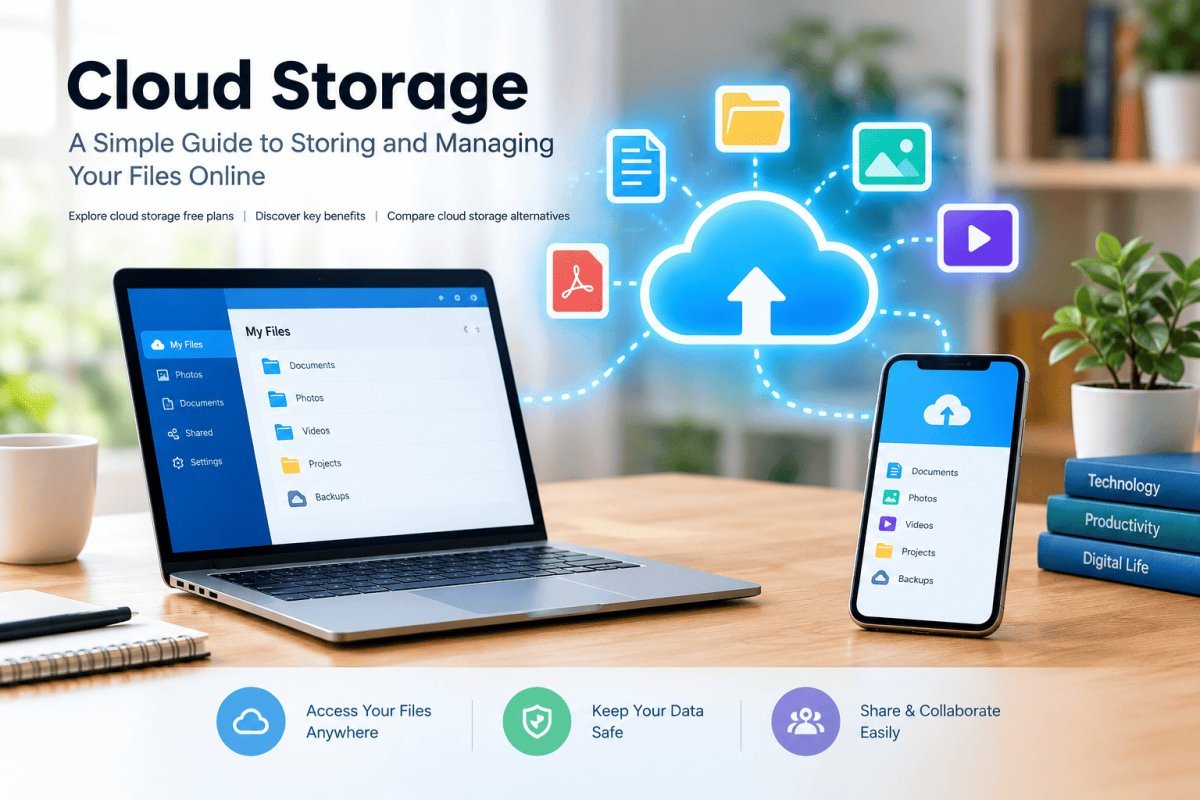
Cloud storage is a simple way to save your files online instead of keeping them only on your computer, phone, or USB drive. Photos, videos, documents, presentations, and other digital files can be uploaded to a cloud storage service and accessed through the internet.
Think of it as an online storage space for your files. Instead of carrying a hard drive everywhere, you can sign in to your account and access your data from a supported smartphone, tablet, laptop, or desktop computer.
Cloud storage has become popular because people are creating more digital content than ever. A single smartphone can contain thousands of photos and videos, while students and businesses may have hundreds of documents to manage.
How Does Cloud Storage Work?
Cloud storage works by storing your files on remote servers operated by a service provider. When you upload a file, it travels through the internet to the provider's servers.
You can then access the file through an app or website. Many services also offer synchronization, which keeps files updated across multiple devices.
For example, you could upload a document from your laptop and later open it from your smartphone. If synchronization is enabled, changes made to the document can also appear on your other connected devices.
This makes cloud storage useful for people who regularly switch between devices.
Why Is Cloud Storage Useful?
There are several reasons why individuals, students, and businesses use cloud storage.
Access Files From Anywhere
One of the biggest advantages of cloud storage is accessibility. You don't need to carry a USB drive or external hard disk everywhere.
As long as you have an internet connection and the correct account access, you can usually open your files from different devices.
Save Space on Your Devices
Large videos, photos, and documents can quickly fill up a phone or computer.
Moving some files to cloud storage can help reduce the amount of space used on your device. This is particularly useful for people who have devices with limited storage.
Share Files Easily
Sharing a large file through email isn't always convenient. Cloud storage services often allow users to create a link to a file or folder.
You can then share that link with friends, classmates, customers, or colleagues, depending on the permissions available.
Support Collaboration
Cloud storage can make teamwork easier. Students can share project files with classmates, while businesses can give employees access to documents they need.
Some services also provide real-time collaboration, allowing multiple people to work on supported documents.
Cloud Storage Free Plans: Are They Worth It?
Cloud storage free plans are a good starting point for people who don't need a large amount of storage.
Many cloud storage providers offer a free tier with limited storage. The amount of free space and available features vary between providers and can change over time.
A free plan may be enough if you mainly want to store documents, a small number of photos, or other relatively small files.
However, free storage can fill up quickly if you regularly upload videos or high-resolution photographs.
Before choosing one of the cloud storage free plans available, look beyond the storage limit. Check features such as:
- Available storage space
- File-sharing options
- Device compatibility
- Automatic synchronization
- Security features
- File recovery options
- Collaboration tools
- Upgrade prices
A free plan is useful for testing a service before deciding whether you need a paid subscription.
Benefits of Using Cloud Storage
Cloud storage offers several practical benefits.
1. Convenient File Access
You can access your files without being tied to one physical device. This is especially useful when working from home, school, college, or the office.
2. Easy File Sharing
Instead of copying files to a USB drive, you can share them digitally. Permission settings can also help control who can view or edit a file.
3. Automatic Synchronization
Synchronization can keep your files consistent across connected devices. This saves time and reduces the need to manually transfer updated files.
4. Scalable Storage
Your storage needs may change over time. Cloud services generally provide different storage plans, allowing users to increase capacity when necessary.
5. Useful for Remote Work
People working from different locations can use cloud storage to access shared documents and project files without always being in the same physical location.
Is Cloud Storage Safe?
Security is an important consideration when choosing any online storage service.
Many established providers use security technologies to protect stored data and accounts. However, users should also take responsibility for account security.
Use a strong, unique password and enable two-factor authentication when it is available. Be careful when creating public sharing links, especially for personal or confidential files.
It's also important to understand that cloud storage isn't necessarily a complete backup by itself. If an important file is deleted or overwritten, recovery options depend on the service.
For extremely important data, keeping an additional backup on a separate storage device can provide extra protection.
Cloud Storage for Students
Students can use cloud storage to organize assignments, notes, presentations, PDFs, and other educational files.
For example, you could start an assignment on your laptop at home and access it later from another computer. You can also share project files with classmates when working on group assignments.
This can reduce dependence on USB drives and make school or college work easier to organize.
Cloud Storage for Businesses
Businesses often have large collections of documents, spreadsheets, images, presentations, and other files.
Cloud storage can help employees access authorized files from different locations. It can also support collaboration between team members.
However, businesses should carefully manage user permissions. Employees should only receive access to the files they need for their work.
For sensitive business information, organizations should also consider security policies, access controls, encryption, and separate backup procedures.
Cloud Storage Alternatives
Although cloud storage is convenient, it isn't the only way to store your data. There are several cloud storage alternatives.
External Hard Drives
An external hard drive provides physical storage that you control. It can be useful for storing large amounts of data, including photos, videos, and computer backups.
One limitation is that you need to have the physical drive with you when you want to access the files.
USB Flash Drives
USB flash drives are small and portable. They are useful for transferring documents and other files between compatible devices.
However, they can be lost or damaged, so they shouldn't be the only place where you keep important information.
Network Attached Storage
Network Attached Storage, or NAS, is a storage device connected to a network. It can provide a central location where multiple devices can access files.
NAS can be useful for homes, offices, and users who want greater control over their storage setup.
Local Computer Storage
Your computer's internal storage is another option. Local storage works without an internet connection and is convenient for everyday files.
The main drawback is that hardware failure can cause data loss if you don't have another copy.
Cloud Storage vs. Cloud Storage Alternatives
Choosing between cloud storage and physical storage depends on your needs.
| Feature | Cloud Storage | Physical Storage |
|---|---|---|
| Remote access | Usually available | Usually limited |
| Internet required | Usually for online access | No |
| File sharing | Usually easy | More manual |
| Portability | Access through supported devices | Device must be carried |
| Physical control | Lower | Higher |
| Automatic synchronization | Often available | Usually manual |
| Backup flexibility | Depends on service | User-controlled |
For many people, using both options can be practical. Cloud storage provides convenient access and sharing, while an external drive can provide another copy of important files.
How to Choose the Right Cloud Storage
Choosing a cloud storage service doesn't have to be complicated. Start by thinking about what you actually need.
Consider the following questions:
- How much storage do you need?
- Do you mainly store documents, photos, or videos?
- Which devices do you use?
- Do you need to share files with other people?
- Do you need automatic synchronization?
- Is collaboration important?
- What security features are available?
- What happens if you accidentally delete a file?
- How much does additional storage cost?
If you only need a small amount of space, one of the cloud storage free plans may be enough. If you have a large collection of files, a paid plan or one of the cloud storage alternatives may make more sense.
Frequently Asked Questions About Cloud Storage
What is cloud storage used for?
Cloud storage is used to save, access, synchronize, share, and manage digital files through the internet.
Is cloud storage free?
Some providers offer free storage plans with limited capacity. Paid plans are generally available for users who need more storage or additional features.
What are cloud storage alternatives?
Common cloud storage alternatives include external hard drives, USB flash drives, NAS devices, and local computer storage.
Is cloud storage better than a USB drive?
They serve different purposes. Cloud storage is convenient for remote access and sharing, while a USB drive provides physical storage that can work without an internet connection.
Can I use cloud storage on my phone?
Yes. Many cloud storage services provide mobile applications that allow users to upload, download, view, and manage files from smartphones.
Final Thoughts
Cloud storage provides a convenient way to store and manage digital files without depending entirely on a single physical device. It can be useful for personal photos, school assignments, business documents, and collaborative projects.
For beginners, cloud storage free plans provide an easy way to try online storage without immediately paying for a subscription. As your needs grow, you can consider upgrading your plan.
At the same time, cloud storage alternatives such as external hard drives, USB drives, NAS devices, and local storage remain useful. For important files, using cloud storage together with a separate physical backup can provide a practical approach to managing your data.
The right solution ultimately depends on how much data you have, how often you need to access it, and how you prefer to manage your files.



Comments
Comments (0)
Security Check
Please complete the captcha to verify you are human.