
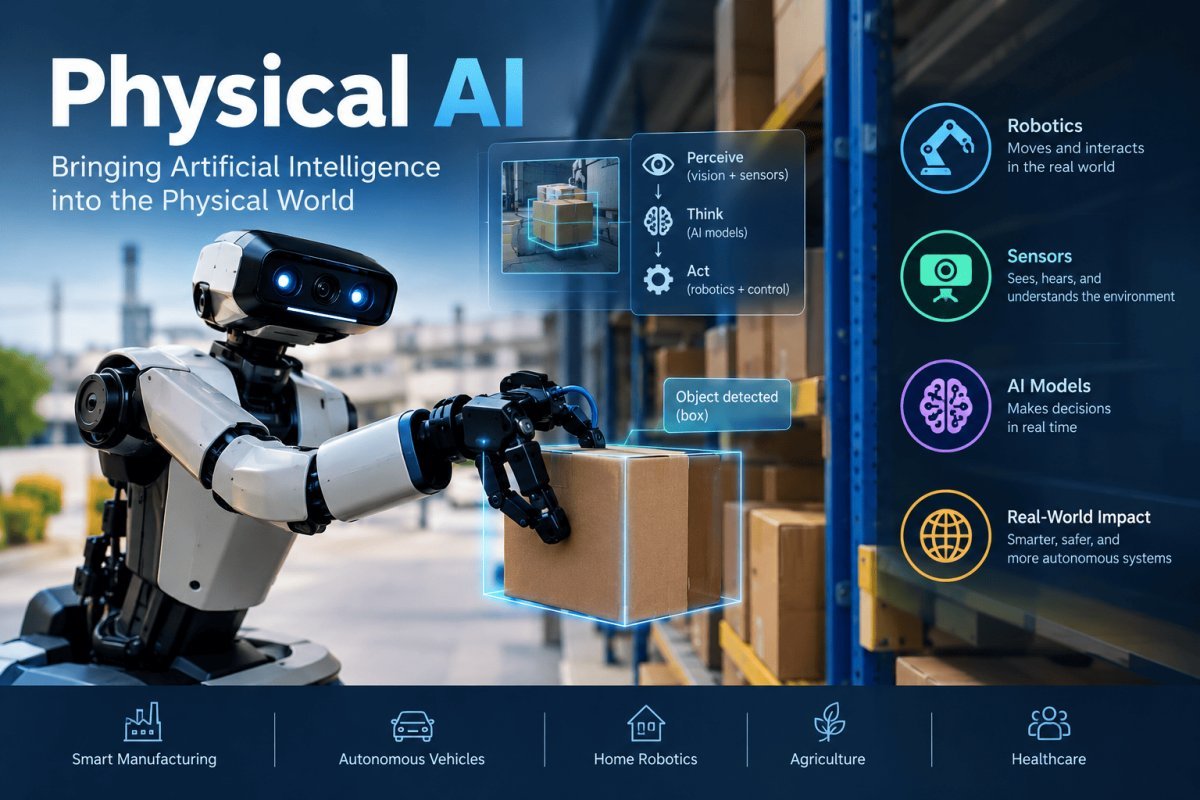
Physical AI is changing the way artificial intelligence interacts with the world around us. Unlike traditional AI, which mainly works with data, text, or digital systems, Physical AI allows intelligent machines to sense their surroundings, make decisions, and take action in the physical world.
From smart factories and warehouses to healthcare and autonomous vehicles, this technology is creating new possibilities for automation and robotics.
What Is Physical AI?
Physical AI refers to artificial intelligence systems that can understand and interact with physical environments. These systems combine AI models with sensors, cameras, robotics, and advanced computing to help machines respond to real-world situations.
For example, a robot working in a warehouse can recognize objects, understand where they are located, plan a movement, and safely pick them up. This combination of perception, reasoning, and action makes Physical AI different from software-based AI alone.
1. AI-Powered Robotics
AI-Powered Robotics is one of the most important applications of Physical AI. Robots can use artificial intelligence to understand their environment and perform tasks with greater flexibility.
Modern robots can assist with manufacturing, warehouse operations, inspection, delivery, and other repetitive or physically demanding activities. As AI models become more capable, robots can handle a wider range of tasks instead of being limited to a single programmed movement.
2. Real-World AI
Real-World AI connects artificial intelligence with physical environments. A machine needs to understand what is happening around it before it can respond appropriately.
Sensors and cameras provide information about objects, movement, distance, temperature, and other conditions. AI systems can process this information and determine what action should happen next.
This capability is particularly useful when conditions are constantly changing. A robot in a busy workplace, for example, may need to adjust its movements when people or objects appear in its path.
3. Computer Vision
Computer Vision gives intelligent machines the ability to interpret visual information. Cameras can capture images and video, while AI models analyze what they contain.
In robotics, computer vision can help identify objects, recognize locations, detect obstacles, and understand changes in an environment. This allows machines to make more informed decisions instead of relying only on fixed instructions.
Computer vision is therefore an important part of Physical AI, particularly in applications where robots need to interact safely with people and objects.
4. Autonomous Machines
Autonomous Machines can perform tasks with limited human intervention. They use AI, sensors, software, and other technologies to perceive their surroundings and choose appropriate actions.
Examples include autonomous mobile robots, agricultural machines, drones, and self-driving systems. The level of autonomy can vary, with some machines requiring human supervision while others can complete specific tasks independently.
The goal is not simply to make machines operate without people, but to enable them to handle appropriate tasks more intelligently and efficiently.
5. Smart Automation
Smart Automation combines artificial intelligence, robotics, sensors, and software to improve physical processes. Traditional automation often follows predefined instructions, while AI-based systems can respond to changing conditions.
For businesses, this can support applications such as quality inspection, inventory movement, production, and equipment monitoring. By combining automation with AI, organizations can create systems that are more adaptable to real-world situations.
The Future of Physical AI
The future of Physical AI is closely connected to advances in robotics, AI models, sensors, and computing. Humanoid robots and other intelligent machines are being developed to operate in environments designed for humans.
However, challenges remain. Physical AI systems need to operate safely, understand unpredictable environments, and work reliably around people. Cost, energy use, data requirements, and responsible deployment are also important considerations.
As these technologies continue to develop, Physical AI could become an important part of factories, transportation, healthcare, agriculture, logistics, and everyday life.
Conclusion
Physical AI brings artificial intelligence into the physical world by combining intelligent software with machines, sensors, and robotics. AI-Powered Robotics, Real-World AI, Computer Vision, Autonomous Machines, and Smart Automation are key areas helping this technology develop.
The most important change is that machines are becoming better at understanding their surroundings and responding to them. As the technology matures, Physical AI has the potential to make many physical tasks more intelligent, flexible, and automated.


Comments
Comments (0)
Security Check
Please complete the captcha to verify you are human.