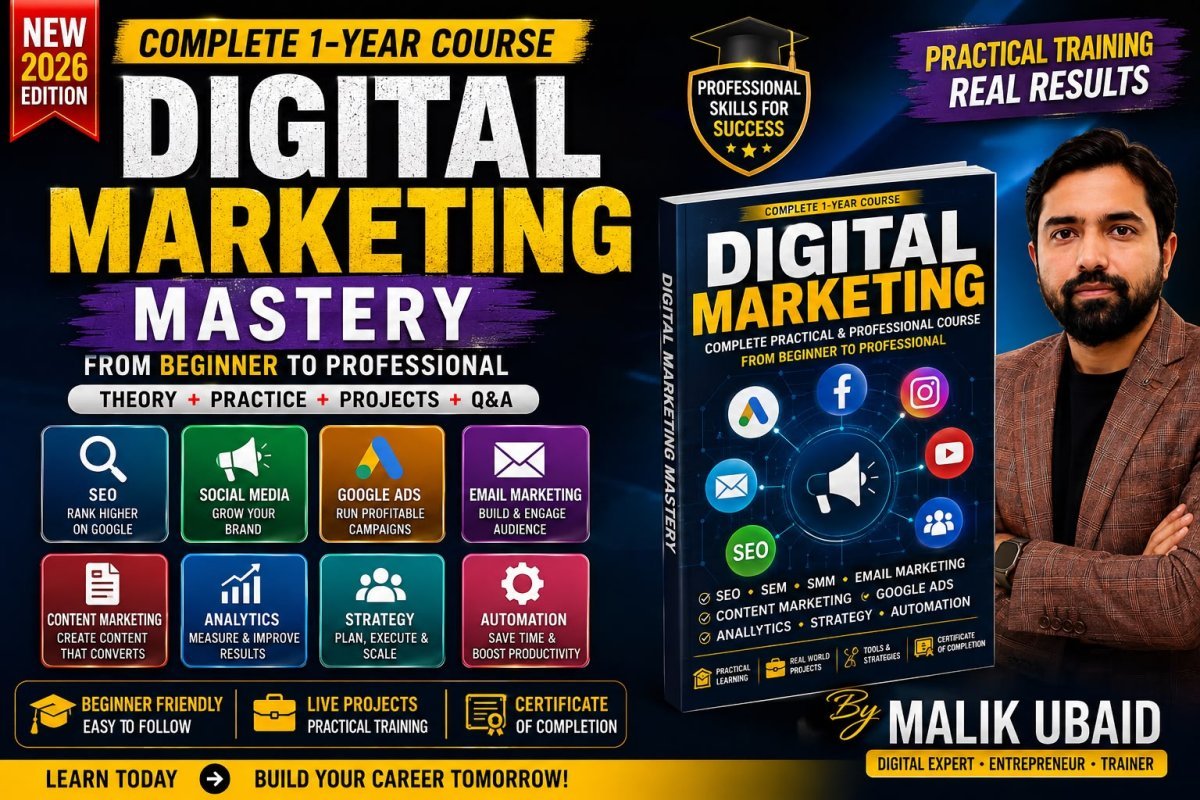
The FSC INTERTECH DIGITAL MARKETING Course is a complete digital marketing study book for FSc InterTech students in Pakistan. This guide covers website marketing, content strategy, social media marketing, search engine optimization (SEO), Google Ads, Meta Ads, email marketing, analytics, and artificial intelligence—from beginner to advanced level.
Students in the InterTech program can also read our related FSc InterTech Graphic Designing Book to build design skills alongside marketing. This course book is prepared by Malik Ubaid, digital marketing educator at malikubaid.com.
-
📘 FSC INTERTECH DIGITAL MARKETING BOOK
Complete Digital Marketing Full Course
Beginner to Advanced with AI & Practical Training
TABLE OF CONTENTS
PART 1 — DIGITAL MARKETING FOUNDATION
PART 2 — WEBSITE & CONTENT
PART 3 — SOCIAL MEDIA MARKETING
- Social Media Marketing
- Social Media Content & Management
- Facebook & Instagram Marketing
- Video Marketing
PART 4 — SEARCH ENGINE OPTIMIZATION
PART 5 — PAID ADVERTISING
PART 6 — EMAIL & SALES
PART 7 — ANALYTICS & ARTIFICIAL INTELLIGENCE
PART 8 — PROFESSIONAL DIGITAL MARKETING
PART 1
DIGITAL MARKETING FOUNDATION
CHAPTER 1
INTRODUCTION TO DIGITAL MARKETING
Learning Objectives
After completing this chapter, students will be able to:
- Understand digital marketing.
- Explain the difference between traditional and digital marketing.
- Identify major digital marketing channels.
- Understand the importance of digital marketing.
- Explain how AI can support digital marketing.
1.1 What is Digital Marketing?
Digital marketing is the promotion of products, services, businesses, or brands using digital technologies and online channels.
Examples include:
- Websites
- Search engines
- YouTube
- TikTok
- Online advertising
- Mobile applications
For example, if a clothing shop creates an Instagram page, posts pictures of its clothes, runs advertisements, and receives orders through WhatsApp, it is using digital marketing.
1.2 Traditional Marketing
Traditional marketing uses offline communication methods.
Examples include:
- Television advertisements
- Radio
- Newspapers
- Magazines
- Billboards
- Flyers
- Brochures
- Posters
Traditional marketing can still be useful, but digital marketing provides many additional opportunities for targeting, interaction, measurement, and optimization.
1.3 Digital Marketing vs Traditional Marketing
Traditional Marketing Digital Marketing Television YouTube Newspaper Website/Blog Radio Podcasts Billboard Social Media Flyers Email Printed Brochure Digital Content
1.4 Why is Digital Marketing Important?
Digital marketing helps businesses:
- Reach potential customers.
- Build brand awareness.
- Generate leads.
- Increase sales.
- Communicate with customers.
- Promote products and services.
- Measure campaign performance.
- Build long-term relationships.
1.5 Major Digital Marketing Areas
A digital marketer may work with:
- SEO
- Social media marketing
- Content marketing
- Email marketing
- Google Ads
- Meta Ads
- Video marketing
- Influencer marketing
- Affiliate marketing
- Analytics
- AI-assisted marketing
🤖 AI in Digital Marketing
Artificial Intelligence can assist marketers with:
- Content ideas
- Social media captions
- Blog outlines
- Advertising copy
- Keyword research
- Customer research
- Image generation
- Video ideas
- Data analysis
- Email drafts
AI should be treated as an assistant. Important information should be reviewed and verified before publication.
Practical Activity
Choose a local business and identify five digital marketing methods it could use.
Example:
Business: Local Restaurant
Short Questions & Answers
Q1. What is digital marketing?
Answer: Digital marketing is the promotion of products, services, or brands through digital channels.Q2. What is traditional marketing?
Answer: Traditional marketing uses offline channels such as television, newspapers, radio, and billboards.Q3. What is SEO?
Answer: SEO stands for Search Engine Optimization and focuses on improving visibility in search engine results.Q4. What is social media marketing?
Answer: It is the use of social media platforms to promote businesses, products, services, or content.Q5. Name five digital marketing channels.
Answer: Website, SEO, social media, email marketing, and online advertising.Q6. Why is digital marketing important?
Answer: It helps businesses reach customers, generate leads, increase sales, and measure marketing performance.Q7. What is online advertising?
Answer: Online advertising is paid promotion through digital platforms.Q8. How can AI help digital marketers?
Answer: AI can help with research, content creation, planning, advertising, and analysis.
MCQs
1. What does SEO stand for?
A. Search Engine Optimization
B. Social Email Optimization
C. Search Engine Operation
D. Sales Engine OptimizationAnswer: A
2. Which is a digital marketing channel?
A. Billboard
B. Newspaper
C. Instagram
D. FlyerAnswer: C
3. Which technology can assist marketers with content creation?
A. AI
B. Printer
C. Scanner
D. KeyboardAnswer: A
4. Which one is traditional marketing?
A. SEO
B. Facebook Ads
C. Newspaper advertisement
D. EmailAnswer: C
5. What is the main purpose of marketing?
A. To reach and influence customers
B. To repair computers
C. To install software
D. To create databasesAnswer: A
True/False
- Digital marketing uses digital channels. True
- SEO means Search Engine Optimization. True
- Facebook is an offline marketing channel. False
- AI can assist digital marketers. True
- Newspapers are a digital marketing platform. False
Chapter Assignment
Create a one-page digital marketing plan for a local restaurant.
CHAPTER 2
DIGITAL MARKETING CHANNELS
Learning Objectives
Students will learn:
- Major digital marketing channels.
- Organic and paid marketing.
- Website marketing.
- Search marketing.
- Social media.
- Email marketing.
- Video marketing.
2.1 Website Marketing
A website is an important digital asset for a business.
It can be used to:
- Provide information.
- Sell products.
- Collect leads.
- Publish articles.
- Receive bookings.
- Display services.
- Build credibility.
2.2 Search Engine Marketing
Search engine marketing involves marketing through search engines.
It has two major areas:
SEO: Organic search visibility.
Paid Search: Paid advertisements shown through search advertising systems.
2.3 Social Media Marketing
Social media allows businesses to communicate directly with audiences.
Popular platforms include:
2.4 Email Marketing
Email marketing allows businesses to communicate with subscribers and customers.
It can be used for:
- Newsletters
- Offers
- Product announcements
- Customer education
- Follow-up
- Lead nurturing
2.5 Content Marketing
Content marketing focuses on creating useful content.
Examples:
2.6 Organic vs Paid Marketing
Organic marketing: Content or visibility gained without directly paying for each distribution placement.
Paid marketing: Marketing where money is spent to distribute advertisements or promotional messages.
🤖 AI Practical
Ask an AI assistant:
"Create 10 digital marketing ideas for a small clothing business in Pakistan. Divide the ideas into social media, SEO, email, and advertising."
Students should review the output and improve it.
Short Questions & Answers
Q1. What is a website?
Answer: A website is a collection of connected web pages available through the internet.Q2. What is content marketing?
Answer: Content marketing is creating and distributing useful content to attract and engage an audience.Q3. What is email marketing?
Answer: Email marketing uses email to communicate with customers and prospects.Q4. What is organic marketing?
Answer: Organic marketing refers to marketing activities that do not directly pay for each advertising placement.Q5. What is paid marketing?
Answer: Paid marketing involves paying to distribute advertisements or promotional content.
MCQs
1. Which is a search engine?
A. Google
B. Photoshop
C. Excel
D. WordAnswer: A
2. Which channel uses email?
A. Email marketing
B. SEO
C. Video editing
D. Graphic designAnswer: A
3. Which is a social media platform?
A. Instagram
B. MySQL
C. PHP
D. WindowsAnswer: A
Assignment
Choose a business and identify:
- 2 social media channels
- 1 SEO method
- 1 email marketing method
- 1 paid advertising method
- 3 content ideas
CHAPTER 3
DIGITAL MARKETING STRATEGY
3.1 What is a Marketing Strategy?
A marketing strategy is a planned approach for achieving business and marketing objectives.
A strategy answers questions such as:
- Who are we targeting?
- What are we offering?
- Where can we reach customers?
- What message should we communicate?
- What action do we want customers to take?
- How will we measure results?
3.2 SMART Goals
SMART goals are:
- S — Specific
- M — Measurable
- A — Achievable
- R — Relevant
- T — Time-Bound
Example:
"Generate 100 qualified leads from Facebook within 30 days."
This is better than simply saying:
"Get more customers."
3.3 Target Audience
A target audience is the group of people a business wants to reach.
Factors can include:
- Age
- Location
- Interests
- Needs
- Problems
- Buying behavior
3.4 Competitor Analysis
Competitor analysis means studying competing businesses.
A marketer can examine:
- Products
- Prices
- Website
- Social media
- Content
- Advertising
- Reviews
- Customer experience
3.5 SWOT Analysis
SWOT means:
S — Strengths
W — Weaknesses
O — Opportunities
T — Threats
Short Questions & Answers
Q1. What is a digital marketing strategy?
Answer: It is a planned approach for achieving marketing objectives through digital channels.Q2. What does SMART stand for?
Answer: Specific, Measurable, Achievable, Relevant, and Time-Bound.Q3. What is a target audience?
Answer: A target audience is the group of people a business wants to reach.Q4. What is competitor analysis?
Answer: It is the process of studying competitors and their products, strategies, and marketing activities.Q5. What does SWOT stand for?
Answer: Strengths, Weaknesses, Opportunities, and Threats.Q6. What is a KPI?
Answer: KPI stands for Key Performance Indicator.
MCQs
1. What does S in SMART represent?
A. Social
B. Specific
C. Search
D. SalesAnswer: B
2. What does SWOT analyze?
A. Computers
B. Marketing environment
C. Programming
D. Internet speedAnswer: B
PART 2
WEBSITE & CONTENT
CHAPTER 4
WEBSITE & LANDING PAGES
4.1 What is a Website?
A website is a collection of webpages available through the internet.
Businesses use websites for:
- Information
- Sales
- Lead generation
- Bookings
- Customer support
- Branding
4.2 Domain Name
A domain is the address of a website.
Example:
example.com
4.3 Web Hosting
Web hosting stores website files and makes them available online.
4.4 Landing Page
A landing page is a focused page designed to encourage visitors to complete a particular action.
Examples:
- Buy a product
- Submit a form
- Book an appointment
- Download a guide
- Contact the business
4.5 Call to Action
CTA means Call to Action.
Examples:
- Buy Now
- Register Now
- Contact Us
- Download Now
- Get Started
4.6 Lead Generation
Lead generation is the process of attracting potential customers and collecting inquiries or contact information.
Short Questions & Answers
Q1. What is a domain name?
Answer: A domain name is the human-readable address of a website.Q2. What is web hosting?
Answer: Web hosting stores website files and makes them available online.Q3. What is a landing page?
Answer: A landing page is designed to encourage visitors to complete a specific action.Q4. What is CTA?
Answer: CTA stands for Call to Action.Q5. Give three examples of CTAs.
Answer: Buy Now, Contact Us, and Register Now.Q6. What is conversion?
Answer: Conversion occurs when a visitor completes a desired action.
MCQs
1. Which is a domain name?
A. example.com
B. Google Chrome
C. Windows
D. PhotoshopAnswer: A
2. CTA means:
A. Call to Action
B. Click Through Advertisement
C. Customer Target Analysis
D. Content Traffic AreaAnswer: A
CHAPTER 5
CONTENT MARKETING
5.1 What is Content Marketing?
Content marketing involves creating and distributing valuable, relevant content to attract and engage a target audience.
5.2 Types of Content
Common types include:
5.3 Content Strategy
A content strategy defines:
- What content to create
- Who will receive it
- Where it will be published
- When it will be published
- What objective it supports
5.4 Content Pillars
Content pillars are major topics used to organize content.
For a digital marketing institute:
- Education
- Career
- Student Success
- Digital Marketing Tips
- Industry News
🤖 AI Content Creation
AI can help generate:
- Topics
- Headlines
- Outlines
- Captions
- Content calendars
- Scripts
However, students should fact-check and edit AI-generated content.
Short Questions & Answers
Q1. What is content marketing?
Answer: It is the creation and distribution of useful content to attract and engage an audience.Q2. Name five types of content.
Answer: Blogs, videos, images, podcasts, and infographics.Q3. What is a content strategy?
Answer: It is a plan for creating, publishing, distributing, and measuring content.Q4. What is a content pillar?
Answer: A content pillar is a major topic around which related content is created.Q5. How can AI help content marketing?
Answer: AI can help generate ideas, outlines, captions, scripts, and content plans.
CHAPTER 6
COPYWRITING
6.1 What is Copywriting?
Copywriting is writing designed to persuade people to take an action.
Examples:
- Advertisement
- Product description
- Sales page
- Social media caption
6.2 AIDA
AIDA stands for:
Attention → Interest → Desire → Action
Example:
Attention: Learn Digital Marketing.
Interest: Learn SEO, social media, advertising and AI.
Desire: Build practical skills for your career.
Action: Enroll today.
6.3 PAS
PAS stands for:
Problem → Agitate → Solution
Example:
Problem: Can't generate enough customers?
Agitate: Without a proper marketing strategy, potential customers may choose competitors.
Solution: Use a structured digital marketing strategy.
Short Questions & Answers
Q1. What is copywriting?
Answer: Copywriting is persuasive writing designed to encourage an audience to take action.Q2. What does AIDA stand for?
Answer: Attention, Interest, Desire, and Action.Q3. What does PAS stand for?
Answer: Problem, Agitate, and Solution.Q4. What is a headline?
Answer: A headline is the main statement designed to attract attention.Q5. What is persuasive writing?
Answer: Writing designed to influence a reader's decision or action.
PART 3
SOCIAL MEDIA MARKETING
CHAPTER 7
SOCIAL MEDIA MARKETING
7.1 What is Social Media Marketing?
Social media marketing is the use of social media platforms to achieve marketing objectives.
Popular platforms include:
7.2 Benefits
Social media can help businesses:
- Build awareness
- Engage customers
- Generate leads
- Promote products
- Build communities
- Receive feedback
7.3 Organic Social Media
Organic social media means publishing and engaging without directly paying for advertising distribution.
7.4 Paid Social Media
Paid social media involves advertising through social media platforms.
Short Questions & Answers
Q1. What is social media marketing?
Answer: It is the use of social platforms to promote businesses, products, services, or content.Q2. Name five social platforms.
Answer: Facebook, Instagram, YouTube, TikTok, and LinkedIn.Q3. What is organic marketing?
Answer: Marketing that does not directly pay for each distribution placement.Q4. What is paid social marketing?
Answer: Marketing where businesses pay platforms to distribute advertisements.Q5. What is engagement?
Answer: Engagement includes actions such as likes, comments, shares, saves, and clicks.
CHAPTER 8
SOCIAL MEDIA CONTENT & MANAGEMENT
8.1 Content Calendar
A content calendar helps marketers plan:
Example:
Day Platform Content Monday Facebook Educational post Tuesday Instagram Reel Wednesday YouTube Tutorial Thursday Facebook Customer story Friday Instagram Offer
8.2 Reels
Reels are short-form videos designed for social media platforms.
They can be:
- Educational
- Entertaining
- Promotional
- Inspirational
8.3 Stories
Stories are temporary content formats used for frequent updates and interaction.
8.4 Hashtags
Hashtags help categorize and discover content.
Example:
#DigitalMarketing
#SEO
#SocialMediaMarketing
Short Questions & Answers
Q1. What is a content calendar?
Answer: It is a schedule for planning and publishing content.Q2. What is a Reel?
Answer: A Reel is a short-form video format used on social platforms.Q3. What is a hashtag?
Answer: A hashtag is a word or phrase preceded by # and used to categorize content.Q4. Why is consistency important?
Answer: Consistency helps maintain audience engagement and brand recognition.Q5. What is social media scheduling?
Answer: It means preparing content in advance and scheduling it for publication.
CHAPTER 9
FACEBOOK & INSTAGRAM MARKETING
9.1 Facebook Marketing
Businesses can use Facebook for:
9.2 Instagram Marketing
Instagram is heavily focused on visual content.
Businesses can use:
- Posts
- Stories
- Reels
- Carousels
- Direct messages
- Advertisements
9.3 Meta Business Tools
Meta provides tools that help businesses manage their social media presence and advertising activities.
9.4 Facebook Groups
Groups allow communities to communicate around common interests.
Businesses can use communities for:
- Education
- Customer support
- Discussions
- Brand communities
Short Questions & Answers
Q1. What is a Facebook Page?
Answer: A public presence that businesses and organizations can use to communicate with audiences.Q2. What is Instagram?
Answer: A social media platform focused strongly on visual content.Q3. What is a Facebook Group?
Answer: A community space where people communicate around shared interests.Q4. What is a Reel?
Answer: A short-form video format.Q5. What is organic reach?
Answer: The number of people who see content without direct paid distribution.
CHAPTER 10
VIDEO MARKETING
10.1 What is Video Marketing?
Video marketing uses video content to educate, entertain, inform, or promote.
10.2 Types of Marketing Videos
- Tutorials
- Product demonstrations
- Reviews
- Interviews
- Reels
- Shorts
- Advertisements
- Testimonials
10.3 Video Script
A video script plans what will be said and shown.
Basic structure:
- Hook
- Problem
- Information
- Solution
- CTA
10.4 Thumbnail
A thumbnail is a preview image for a video.
A good thumbnail should be:
- Clear
- Relevant
- Easy to understand
- Visually attractive
🤖 AI Video Marketing
AI can assist with:
- Scripts
- Storyboards
- Voiceovers
- Captions
- Editing
- Video concepts
Short Questions & Answers
Q1. What is video marketing?
Answer: It is the use of videos to promote, educate, inform, or engage audiences.Q2. What is a video script?
Answer: A planned text or structure used to create a video.Q3. What is a thumbnail?
Answer: A preview image representing a video.Q4. What is video SEO?
Answer: Optimizing video content to improve its visibility and discovery.Q5. How can AI help video marketing?
Answer: AI can help with scripts, captions, editing, ideas, and other production tasks.
PART 4
SEARCH ENGINE OPTIMIZATION
CHAPTER 11
SEARCH ENGINE OPTIMIZATION (SEO)
11.1 What is SEO?
SEO stands for Search Engine Optimization.
It is the process of improving websites and online content to increase visibility in search engine results.
11.2 Why SEO Matters
SEO can help businesses:
- Increase organic visibility
- Attract relevant visitors
- Build online presence
- Generate leads
- Support sales
11.3 Types of SEO
On-Page SEO
Optimization within a webpage.
Examples:
Off-Page SEO
Activities outside the website that can support authority and visibility.
Technical SEO
Technical improvements related to:
- Crawling
- Indexing
- Performance
- Mobile accessibility
- Website structure
Local SEO
Optimization for location-based searches.
11.4 Backlinks
A backlink is a link from another website to your website.
Relevant, trustworthy links can contribute to a website's authority.
Short Questions & Answers
Q1. What does SEO stand for?
Answer: Search Engine Optimization.Q2. What is SEO?
Answer: SEO is the process of improving websites and content for better search visibility.Q3. What is on-page SEO?
Answer: SEO activities performed within a webpage.Q4. What is off-page SEO?
Answer: SEO activities performed outside the website.Q5. What is technical SEO?
Answer: Technical optimization related to crawling, indexing, performance, and website structure.Q6. What is local SEO?
Answer: SEO focused on improving visibility for location-based searches.Q7. What is a backlink?
Answer: A link from another website to your website.
CHAPTER 12
KEYWORD RESEARCH & CONTENT SEO
12.1 What is a Keyword?
A keyword is a word or phrase people use when searching online.
Example:
"digital marketing course in Rawalpindi"
12.2 Keyword Research
Keyword research identifies relevant search terms used by potential customers.
12.3 Short-Tail Keywords
Short and broad terms.
Example:
Digital Marketing
12.4 Long-Tail Keywords
More specific search phrases.
Example:
Best digital marketing course for FSC students
Long-tail keywords can be more specific to a particular search intent.
12.5 Search Intent
Search intent is the reason behind a user's search.
Common types include:
- Informational
- Navigational
- Commercial
- Transactional
12.6 SEO Title
The title tells users and search engines what a page is about.
12.7 Meta Description
A meta description provides a short summary of a webpage that may appear in search results.
Short Questions & Answers
Q1. What is a keyword?
Answer: A word or phrase used by users in search engines.Q2. What is keyword research?
Answer: The process of identifying relevant search terms.Q3. What is a short-tail keyword?
Answer: A broad search phrase containing relatively few words.Q4. What is a long-tail keyword?
Answer: A more specific search phrase.Q5. What is search intent?
Answer: The purpose behind a user's search.Q6. What is keyword stuffing?
Answer: Excessive and unnatural use of keywords in content.
PART 5
PAID ADVERTISING
CHAPTER 13
GOOGLE ADS
13.1 What is Google Ads?
Google Ads is Google's advertising platform that allows businesses to create paid campaigns.
13.2 Types of Google Advertising
Depending on available campaign types and objectives, Google advertising can include:
- Search
- Display
- YouTube/video
- Shopping
- App-related campaigns
13.3 Search Ads
Search ads may appear when users search for relevant terms.
13.4 CPC
CPC means Cost Per Click.
It measures the cost associated with a click.
13.5 CTR
CTR means Click-Through Rate.
Formula:
CTR = Clicks ÷ Impressions × 100
13.6 Conversion
A conversion is a desired action such as:
- Purchase
- Registration
- Lead submission
- Phone call
Short Questions & Answers
Q1. What is Google Ads?
Answer: It is Google's platform for creating paid advertising campaigns.Q2. What is CPC?
Answer: Cost Per Click.Q3. What is CTR?
Answer: Click-Through Rate.Q4. What is an impression?
Answer: An impression occurs when an advertisement is displayed.Q5. What is a conversion?
Answer: A desired action completed by a user.Q6. What is an advertising budget?
Answer: The amount allocated for advertising.
CHAPTER 14
META ADS
14.1 What are Meta Ads?
Meta Ads are paid advertisements delivered through Meta's advertising system.
14.2 Basic Campaign Structure
A typical Meta advertising structure includes:
Campaign → Ad Set → Ad
The exact options can vary depending on the advertising objective and platform updates.
14.3 Campaign Objective
The objective defines the main outcome a campaign is designed to achieve.
14.4 Audience
An audience is the group of people the advertisement is intended to reach.
14.5 Creative
Creative includes:
14.6 Retargeting
Retargeting involves showing relevant marketing to people who previously interacted with a business or its digital assets, where appropriate.
Short Questions & Answers
Q1. What are Meta Ads?
Answer: Paid advertisements delivered through Meta's advertising system.Q2. What is an ad creative?
Answer: The visual and written content used in an advertisement.Q3. What is an audience?
Answer: The group of people an advertisement is intended to reach.Q4. What is retargeting?
Answer: Marketing to people who previously interacted with a business or digital asset.Q5. Why test different creatives?
Answer: Testing helps identify which messages and designs perform better.
PART 6
EMAIL & SALES
CHAPTER 15
EMAIL MARKETING
15.1 What is Email Marketing?
Email marketing involves sending marketing or informational emails to people who have appropriately subscribed or otherwise have a valid basis to receive them.
15.2 Types of Emails
- Welcome emails
- Newsletters
- Promotional emails
- Educational emails
- Product announcements
- Follow-up emails
15.3 Email List
An email list contains contacts who have subscribed or otherwise may lawfully receive communications.
Businesses should respect applicable privacy and anti-spam requirements.
15.4 Email Automation
Automation sends emails based on predefined triggers or conditions.
Example:
A person subscribes → Welcome email is sent automatically.
15.5 Open Rate
Open rate attempts to measure how many delivered emails were opened, but modern privacy technologies can affect accuracy.
15.6 Click-Through Rate
Email CTR measures clicks on links or calls to action within emails.
Short Questions & Answers
Q1. What is email marketing?
Answer: It is the use of email to communicate with customers and prospects for marketing purposes.Q2. What is a newsletter?
Answer: A regularly distributed email containing useful information or updates.Q3. What is a welcome email?
Answer: An email sent to a new subscriber or customer.Q4. What is email automation?
Answer: Automatically sending emails based on predefined triggers.Q5. What is a lead magnet?
Answer: A useful resource offered to attract potential customers and encourage them to provide contact information.
CHAPTER 16
LEAD GENERATION & SALES FUNNEL
16.1 What is a Lead?
A lead is a potential customer who has shown interest in a product or service.
16.2 Lead Generation
Lead generation is attracting potential customers and generating inquiries or contact information.
Methods include:
- Website forms
- Landing pages
- Social media
- Search marketing
- Advertisements
- Email campaigns
- WhatsApp communication
16.3 Sales Funnel
A sales funnel represents the stages through which potential customers may move toward becoming customers.
TOFU
Top of Funnel — Awareness.
MOFU
Middle of Funnel — Consideration.
BOFU
Bottom of Funnel — Decision/Conversion.
16.4 Lead Nurturing
Lead nurturing involves providing relevant information and communication to potential customers over time.
Short Questions & Answers
Q1. What is a lead?
Answer: A lead is a person or organization that has shown interest in a business offering.Q2. What is lead generation?
Answer: The process of attracting and collecting potential customer inquiries or information.Q3. What is a sales funnel?
Answer: A model showing stages through which potential customers may move toward a purchase.Q4. What does TOFU mean?
Answer: Top of Funnel.Q5. What does MOFU mean?
Answer: Middle of Funnel.Q6. What does BOFU mean?
Answer: Bottom of Funnel.Q7. What is lead nurturing?
Answer: Building relationships with potential customers through relevant communication.
PART 7
ANALYTICS & AI
CHAPTER 17
DIGITAL MARKETING ANALYTICS
17.1 What is Analytics?
Analytics is the process of collecting and analyzing data to understand performance and make better decisions.
17.2 Important Metrics
Reach
Number of unique people/accounts exposed to content or advertising, according to the platform's measurement.
Impressions
Number of times content or advertisements were displayed.
Clicks
Number of times users clicked.
CTR
Click-Through Rate.
CPC
Cost Per Click.
CPA
Cost Per Acquisition/Action.
Conversion Rate
Percentage of relevant users completing a desired action.
ROAS
Return on Ad Spend.
17.3 Google Analytics
Google Analytics can help businesses understand user activity and performance on websites and apps.
17.4 Search Console
Search Console provides information about website visibility and performance in Google Search.
Short Questions & Answers
Q1. What is digital marketing analytics?
Answer: It is the collection and analysis of marketing data to evaluate performance.Q2. What is reach?
Answer: Reach measures unique people/accounts exposed to content or advertising according to the platform's definition.Q3. What are impressions?
Answer: The number of times content or advertising was displayed.Q4. What is CTR?
Answer: Click-Through Rate.Q5. What is CPC?
Answer: Cost Per Click.Q6. What is CPA?
Answer: Cost Per Acquisition or Cost Per Action, depending on the context.Q7. What is ROAS?
Answer: Return on Ad Spend.Q8. Why is analytics important?
Answer: It helps marketers measure results and improve campaigns.
CHAPTER 18
ARTIFICIAL INTELLIGENCE IN DIGITAL MARKETING
18.1 What is AI?
Artificial Intelligence is technology that allows computer systems to perform tasks involving aspects of human intelligence.
18.2 Generative AI
Generative AI can create:
18.3 AI for Content
AI can help marketers create:
- Blog outlines
- Captions
- Headlines
- Scripts
- Content calendars
- Email drafts
18.4 AI for SEO
AI can assist with:
- Topic research
- Keyword ideas
- Content outlines
- SEO suggestions
- Competitor research
AI output should always be reviewed.
18.5 AI for Social Media
AI can assist with:
- Content planning
- Caption generation
- Hashtag ideas
- Scripts
- Creative ideas
- Analysis
18.6 Prompt Engineering
Prompt engineering means creating effective instructions for AI.
Weak prompt:
"Write a post."
Better prompt:
"Write a 100-word Facebook post for a Pakistani digital marketing institute promoting an FSC Intertech Digital Marketing course. Use simple English, a professional tone, and include a clear call to action."
18.7 Responsible AI
Students should understand:
- AI can make mistakes.
- Information should be verified.
- Personal information should be protected.
- Copyright should be respected.
- AI should not be used to deceive people.
- Human judgment remains important.
Short Questions & Answers
Q1. What is AI?
Answer: AI is technology that enables computer systems to perform tasks involving aspects of human intelligence.Q2. What is Generative AI?
Answer: AI capable of generating content such as text, images, audio, video, or code.Q3. What is a prompt?
Answer: A prompt is an instruction given to an AI system.Q4. What is prompt engineering?
Answer: The practice of designing effective instructions for AI systems.Q5. Can AI make mistakes?
Answer: Yes. AI-generated information should be reviewed and verified.Q6. How can AI help social media marketers?
Answer: It can help with content ideas, captions, scripts, calendars, and analysis.Q7. How can AI help SEO?
Answer: It can assist with keyword ideas, content planning, research, and optimization suggestions.
PART 8
PROFESSIONAL DIGITAL MARKETING
CHAPTER 19
FREELANCING & DIGITAL MARKETING CAREER
19.1 What is Freelancing?
Freelancing means working independently for clients on projects or services.
19.2 Digital Marketing Freelance Services
A freelancer can offer:
- SEO
- Social media management
- Content writing
- Google Ads
- Meta Ads
- Email marketing
- Video marketing
- Analytics
- Marketing strategy
19.3 Portfolio
A portfolio demonstrates your skills through examples of your work.
A student can create sample projects even before getting real clients.
19.4 Finding Clients
Potential methods include:
- Freelancing platforms
- Networking
- Social media
- Referrals
- Direct business outreach
- Personal website
19.5 Client Communication
A professional should:
- Understand requirements.
- Set realistic expectations.
- Communicate clearly.
- Meet deadlines.
- Provide updates.
- Protect client information.
19.6 Personal Branding
Personal branding means building a professional identity around your skills, experience, values, and work.
Short Questions & Answers
Q1. What is freelancing?
Answer: Freelancing is working independently for clients on projects or services.Q2. What is a digital marketing freelancer?
Answer: A freelancer who provides digital marketing services to clients.Q3. What is a portfolio?
Answer: A collection of work samples demonstrating skills and experience.Q4. What is Fiverr?
Answer: An online marketplace where freelancers can offer services to clients.Q5. What is Upwork?
Answer: An online platform connecting freelancers and clients for professional projects.Q6. What is personal branding?
Answer: Developing and communicating a professional identity and reputation.Q7. Why is client communication important?
Answer: It helps clarify requirements, manage expectations, and maintain professional relationships.
CHAPTER 20
FINAL DIGITAL MARKETING PROJECT
Project Objective
Students will create a complete digital marketing campaign for a real or fictional business.
Step 1 — Select a Business
Examples:
- Restaurant
- Clothing store
- College
- Real estate company
- E-commerce store
- Beauty salon
- Travel agency
- Software company
Step 2 — Business Research
Students should identify:
- Business name
- Products/services
- Location
- Customers
- Competitors
- Current online presence
Step 3 — Target Audience
Define:
- Age
- Location
- Interests
- Problems
- Needs
- Buying behavior
Step 4 — Marketing Objectives
Create SMART objectives.
Example:
Generate 100 qualified leads within 30 days through digital marketing campaigns.
Step 5 — Competitor Analysis
Analyze at least three competitors.
Study:
- Website
- Social media
- Content
- Offers
- Advertising
- Reviews
- Strengths
- Weaknesses
Step 6 — Website Plan
Create a basic website structure:
- Home
- About
- Services
- Products
- Blog
- Contact
Step 7 — SEO Plan
Include:
- Main keyword
- Secondary keywords
- SEO title
- Meta description
- Content topics
- Internal linking plan
Step 8 — Social Media Plan
Select suitable platforms.
Create:
Step 9 — Content Calendar
Create a 30-day calendar.
Include:
Date Platform Content Format CTA Day 1 Facebook Introduction Image Contact Us Day 2 Instagram Tip Reel Follow Day 3 YouTube Tutorial Video Subscribe Day 4 Facebook Product Image Buy Now
Step 10 — Advertising Plan
Create a basic:
Google Ads Plan
- Objective
- Keywords
- Ad copy
- Budget
- Landing page
- Conversion
Meta Ads Plan
- Objective
- Audience
- Creative
- Budget
- CTA
- Landing page
Step 11 — Email Campaign
Create:
Step 12 — AI Strategy
Explain how AI can be used for:
Include at least 5 AI prompts used during the project.
Step 13 — KPIs
Select appropriate KPIs such as:
Step 14 — Final Report
Students should present:
- Business introduction
- Target audience
- Competitor research
- Marketing objectives
- Website plan
- SEO plan
- Social media strategy
- Content calendar
- Advertising plan
- Email campaign
- AI strategy
- KPIs
- Expected results
- Conclusion
🎓 FINAL EXAMINATION PREPARATION
Important Definitions
Digital Marketing
Promotion of products, services, or brands using digital channels.
SEO
Search Engine Optimization.
SEM
Search Engine Marketing.
SMM
Social Media Marketing.
CTA
Call to Action.
KPI
Key Performance Indicator.
CPC
Cost Per Click.
CTR
Click-Through Rate.
CPA
Cost Per Acquisition/Action.
ROAS
Return on Ad Spend.
AI
Artificial Intelligence.
CRM
Customer Relationship Management.
ROI
Return on Investment.
PPC
Pay-Per-Click.
TOFU
Top of Funnel.
MOFU
Middle of Funnel.
BOFU
Bottom of Funnel.
📝 FINAL MCQs
1. What does SEO stand for?
A. Search Engine Optimization
B. Social Engine Operation
C. Search Email Optimization
D. Sales Engine OperationAnswer: A
2. Which is a social media platform?
A. Instagram
B. MySQL
C. PHP
D. WindowsAnswer: A
3. What does CTA mean?
A. Call to Action
B. Click to Advertise
C. Customer Target Area
D. Content Traffic AnalysisAnswer: A
4. What does CTR stand for?
A. Click-Through Rate
B. Customer Traffic Report
C. Content Target Rate
D. Click Traffic ResultAnswer: A
5. What does CPC stand for?
A. Cost Per Click
B. Customer Per Campaign
C. Content Per Click
D. Cost Per CustomerAnswer: A
6. What does AI stand for?
A. Artificial Intelligence
B. Automated Internet
C. Advanced Information
D. Artificial InternetAnswer: A
7. What does KPI stand for?
A. Key Performance Indicator
B. Key Product Information
C. Knowledge Performance Index
D. Key Promotion InterfaceAnswer: A
8. What does ROAS stand for?
A. Return on Ad Spend
B. Rate of Advertising Sales
C. Return on Audience Strategy
D. Revenue on Advertising SystemAnswer: A
9. Which is a long-tail keyword?
A. Marketing
B. SEO
C. Digital marketing course for FSC students
D. BusinessAnswer: C
10. Which is an example of a CTA?
A. Buy Now
B. Facebook
C. Google
D. MarketingAnswer: A
11. Which technology can generate text and images?
A. Generative AI
B. Calculator
C. Printer
D. RouterAnswer: A
12. What is a landing page?
A. A focused webpage designed to encourage a specific action
B. A computer program
C. A social media account
D. A search engineAnswer: A
13. What does TOFU mean?
A. Top of Funnel
B. Type of Funnel
C. Total Online Funnel
D. Top Online FunctionAnswer: A
14. What does MOFU mean?
A. Middle of Funnel
B. Marketing Online Funnel
C. Main Online Function
D. Media of FunnelAnswer: A
15. What does BOFU mean?
A. Bottom of Funnel
B. Business Online Funnel
C. Brand Online Function
D. Bottom Online FunctionAnswer: A
✅ FINAL TRUE / FALSE
- Digital marketing uses digital channels. True
- SEO stands for Search Engine Optimization. True
- Instagram is a search engine. False
- AI can assist digital marketers. True
- A landing page can be used for lead generation. True
- CPC means Cost Per Click. True
- CTR means Click-Through Rate. True
- Content marketing only means writing blogs. False
- A target audience is a group of intended customers. True
- Analytics can help marketers measure performance. True
- AI-generated information should always be accepted without checking. False
- A content calendar helps organize content publishing. True
- SEO is only about social media. False
- A CTA encourages a user to take an action. True
- A portfolio can help a freelancer demonstrate skills. True
🎯 STUDENT PRACTICAL WORK
Throughout this FSC Intertech Digital Marketing Full Course, students should complete the following practical tasks:
Practical 1
Create a digital marketing plan for a local business.
Practical 2
Create a target audience profile.
Practical 3
Perform a basic competitor analysis.
Practical 4
Create a one-page landing page structure.
Practical 5
Write five social media captions.
Practical 6
Create a 7-day content calendar.
Practical 7
Create five Reel ideas.
Practical 8
Perform basic keyword research.
Practical 9
Write an SEO title and meta description.
Practical 10
Create a sample Google Ads campaign structure.
Practical 11
Create a sample Meta Ads campaign structure.
Practical 12
Write three marketing emails.
Practical 13
Create a basic sales funnel.
Practical 14
Calculate CTR, CPC, conversion rate, and ROAS from sample data.
Practical 15
Use AI to create a marketing strategy.
Practical 16
Create an AI-assisted social media campaign.
Practical 17
Create a freelancer portfolio.
Practical 18
Prepare a complete digital marketing campaign.
🏆 FINAL STUDENT PROJECT
"Create Your Own Digital Marketing Campaign"
Every student must select a business and develop a complete digital marketing plan.
Required Submission
1. Business Introduction
2. Target Audience
3. Buyer Persona
4. Competitor Analysis
5. SMART Marketing Objectives
6. Website Plan
7. SEO Plan
8. Keyword Research
9. Social Media Strategy
10. 30-Day Content Calendar
11. Google Ads Plan
12. Meta Ads Plan
13. Email Campaign
14. Sales Funnel
15. AI Marketing Strategy
16. KPI Dashboard
17. Campaign Report
18. Final Presentation
📊 SUGGESTED FINAL PROJECT MARKING
Area Marks Business Research 10 Target Audience 10 Competitor Analysis 10 Marketing Strategy 15 SEO 10 Social Media 10 Content Calendar 10 Advertising 10 Email Marketing 5 AI Usage 5 Analytics/KPIs 5 Presentation 10 Total 120
📚 FINAL MESSAGE TO STUDENTS
Digital marketing is not only about posting on social media or running advertisements. A successful digital marketer understands customers, content, websites, SEO, social media, advertising, email, analytics, strategy, and AI.
The purpose of this course is to develop both knowledge and practical skills.
Students should not only memorize definitions. They should practice creating campaigns, researching businesses, writing content, analyzing data, using AI responsibly, and communicating professionally.
By completing this course and the final project, students will have a foundation for continuing into areas such as:
- SEO
- Social Media Management
- Content Marketing
- Paid Advertising
- Email Marketing
- E-commerce Marketing
- Analytics
- AI Marketing
- Freelancing
- Digital Entrepreneurship
Learn. Practice. Create. Analyze. Improve.
FSC INTERTECH DIGITAL MARKETING BOOK
Complete Digital Marketing Full Course — Beginner to Advanced with AI & Practical Training

Comments
Comments (0)
Security Check
Please complete the captcha to verify you are human.