
Introduction
Most AI chatbots answer questions
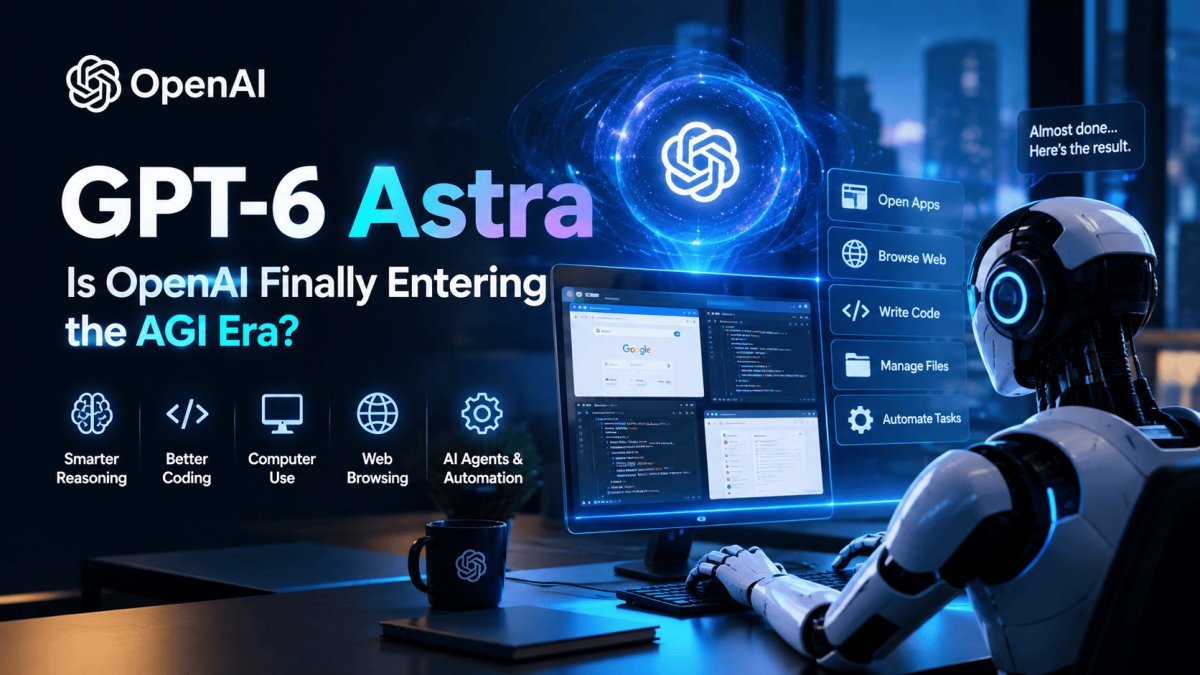
This marks a shift from AI that simply generates text to AI systems that can act in digital environments, interpret what's on your screen, and execute tasks using real software tools
But does this mean we've finally entered the era of artificial general intelligence (AGI)?
What Is GPT-6 Astra?
GPT-6 Astra is OpenAI's most advanced AI model to date, officially released on September 3, 2026, with general availability following on September 4
Key Facts
-
Developer: OpenAI
-
Release Date: September 3, 2026 (limited preview); September 4, 2026 (stable public release)
-
Availability: ChatGPT Plus, Pro, Business, Enterprise users; OpenAI API; AWS Bedrock; Microsoft Azure
-
Context Window: 1,050,000 tokens
-
Max Output: 128,000 tokens
-
API Pricing: $10 per million input tokens, $50 per million output tokens
-
Knowledge Cutoff: April 30, 2026
OpenAI describes GPT-6 Astra as "the world's most intelligent and aligned model," emphasizing its ability to handle tedious, multi-step computer-based tasks that previously required human effort
How It Differs from Earlier OpenAI Models
Previous OpenAI models like GPT-5.6 Sol, Terra, and Luna excelled at answering questions, generating code, and performing single-turn tasks
In short: earlier models told you how to do something
GPT-6 Astra's Biggest Capabilities
OpenAI has highlighted a wide range of advanced capabilities for GPT-6 Astra, many of which have been demonstrated in independent testing and real-world deployments
Advanced Reasoning
GPT-6 Astra achieves near-perfect scores on some of the hardest reasoning benchmarks ever created, including 98.6% on ARC-AGI-3 and 97.6% on FrontierMath Tier 4
-
Example: Ask Astra to solve a multi-step logic puzzle involving constraints and conditional rules
Coding and Software Engineering
OpenAI calls GPT-6 Astra "the best model for software engineering to date."
-
Example: Provide Astra with a buggy Python project
Computer Use
This is Astra's headline feature
-
Example: Ask Astra to "organize my calendar for next week based on my email priorities."
Browser Interaction
GPT-6 Astra can navigate websites, fill out forms, compare options, and extract information—tasks that previously required manual clicking and typing
-
Example: "Find the best flight options from New York to London next month, compare prices, and prepare a travel plan."
Multi-Step Task Execution
Astra excels at workflows that require multiple steps across different tools and applications
-
Example: "Research the latest trends in renewable energy, collect information from five sources, organize it into categories, and create a 10-slide presentation."
Research and Information Synthesis
With its massive 1.05M token context window, GPT-6 Astra can process and synthesize large volumes of information, making it well-suited for research-heavy tasks
-
Example: "Summarize the last 50 research papers on quantum computing breakthroughs and highlight the three most promising approaches."
Mathematics and Science
Astra achieves top scores on advanced mathematics and science benchmarks, including 96% on GPQA Diamond and near-perfect marks on FrontierMath
-
Example: "Solve this differential equation and explain each step in plain language."
Professional Work and Automation
OpenAI says Astra can handle "tedious" computer-based tasks such as tax preparation, legal memo formatting, apartment searches, and customer record updates
-
Example: "Prepare my quarterly tax documents by extracting income data from my spreadsheets and filling out the appropriate forms."
AI-Agent Workflows
GPT-6 Astra is designed to function as an AI agent, meaning it can plan, execute, and monitor tasks with varying degrees of autonomy
-
Example: "Monitor my server logs for anomalies and alert me if anything suspicious is detected."
Can GPT-6 Astra Control Your Computer?
Yes—but with important caveats
GPT-6 Astra is one of the first widely deployed AI models with native computer-use capabilities, meaning it can interact with digital environments by interpreting what is displayed on the screen and taking actions through available tools
How Computer-Use AI Works
-
Observing the screen (via screenshots or accessibility APIs)
-
Interpreting what it sees (buttons, text fields, menus, etc.)
-
Planning the next action (click, type, scroll, etc.)
-
Executing the action through a controlled interface
-
Verifying the result and iterating if needed
OpenAI's implementation allows Astra to work in the app itself: navigate menus, enter information, and inspect results on screen
Realistic Examples of Computer Control
-
Opening websites: "Open the company's CRM and pull up last month's sales data."
-
Navigating webpages: "Go to our analytics dashboard and export the traffic report."
-
Filling forms: "Fill out this vendor onboarding form with the details from my email."
-
Working with software: "Open my code editor, find all instances of this function, and refactor them."
-
Searching for information: "Search our internal wiki for the Q3 budget and summarize it."
-
Performing repetitive tasks: "Rename all files in this folder according to this naming convention."
-
Completing multi-step workflows: "Onboard a new employee by creating their email, adding them to Slack, and scheduling orientation meetings."
Important Limitations
GPT-6 Astra does not magically control every PC out of the box
-
Software and tools being available and properly configured
-
Permissions granted to the AI agent
-
Operating system compatibility and security settings
-
Deployment environment (e.g., sandboxed vs. full access)
-
Safeguards implemented by OpenAI and the organization using Astra
In practice, this means Astra's computer-use capabilities are powerful but bounded by the tools and permissions it's given
GPT-6 Astra vs JARVIS: How Close Are We?
The idea of an AI assistant that can control your computer, browse the web, and automate tasks sounds a lot like JARVIS, Tony Stark's fictional AI from the Marvel universe
Similarities to JARVIS
-
Understands instructions: Like JARVIS, Astra can interpret natural language commands and execute them
-
Can reason about tasks: It can break down complex requests into steps and plan accordingly
-
Interacts with digital environments: Astra can navigate software, browsers, and desktop apps
-
Performs multi-step actions: It can complete workflows that span multiple applications
-
Automates workflows: Repetitive tasks can be delegated to Astra, freeing up human time
Key Differences from JARVIS
-
JARVIS is fictional: It operates without constraints in a sci-fi universe
-
Specific tools and permissions: Astra doesn't automatically have unrestricted control over a computer
-
No unrestricted control: Astra cannot simply control every physical device or bypass security measures
-
Requires safeguards: OpenAI has implemented strict isolation, monitoring, and misalignment detection to prevent unintended actions
The Bottom Line
GPT-6 Astra is a significant step toward JARVIS-like functionality, but it's not JARVIS
Real-World Examples: What Can GPT-6 Astra Actually Do?
Here are five realistic scenarios that illustrate GPT-6 Astra's potential—distinguishing between demonstrated capabilities and potential applications
Example 1: Travel Planning (Demonstrated)
-
Task: "Find the best flight options from San Francisco to Tokyo in October, compare them, and prepare a travel plan."
-
What Astra Can Do: Open websites, search for flights, filter by price and duration, compare options, and compile a summary document with recommendations
-
Status: Demonstrated capability via browser-use and computer-use tools
Example 2: Research Report (Demonstrated)
-
Task: "Research the impact of AI on healthcare, collect information from ten sources, organize it, and create a 15-page report."
-
What Astra Can Do: Browse academic databases, extract key findings, synthesize information, structure the report, and generate the document
-
Status: Demonstrated in OpenAI's examples and independent testing
Example 3: Coding Project Debugging (Demonstrated)
-
Task: "Open my Python project, identify bugs, modify the code, test it, and report the results."
-
What Astra Can Do: Access the codebase, run static analysis, identify errors, suggest and implement fixes, execute tests, and summarize outcomes
-
Status: Demonstrated capability; Astra scores 74.1% on DeepSWE v1.1 for software engineering tasks
Example 4: Administrative Automation (Potential)
-
Task: "Navigate our internal HR portal and complete onboarding paperwork for five new employees."
-
What Astra Could Do: Log into the portal, fill out forms, upload documents, and confirm submissions—assuming proper credentials and permissions are configured
-
Status: Potential application; depends on enterprise plugin availability and security policies
Example 5: Spreadsheet Analysis (Demonstrated)
-
Task: "Analyze this sales spreadsheet, identify trends, and create useful conclusions for the executive team."
-
What Astra Can Do: Read the spreadsheet, perform calculations, generate charts, and write a summary with actionable insights
-
Status: Demonstrated capability; Astra can create documents, spreadsheets, and presentations autonomously
GPT-6 Astra for Developers
Developers are among the most excited about GPT-6 Astra, and for good reason
Why Developers Care
-
Coding: Astra can write, refactor, and optimize code across multiple languages
-
Debugging: It can identify bugs, suggest fixes, and verify corrections
-
Software Engineering: Astra handles real-world engineering tasks, scoring 74.1% on DeepSWE v1.1
-
Codebase Analysis: With a 1.05M token context window, Astra can process large codebases in a single session
-
Automation: Developers can delegate repetitive tasks like testing, documentation, and deployment scripting
-
Agent Development: Astra supports async tool calling, steering, and MCP integration, making it ideal for building AI agents
-
Tool Calling: It can invoke external tools, APIs, and services autonomously
-
Computer-Use Workflows: Developers can create agents that interact with IDEs, terminals, and development environments
Practical Use Cases for Developers
-
Automated Code Reviews: Astra can review pull requests, flag issues, and suggest improvements
-
Test Generation: It can write unit tests, integration tests, and end-to-end tests based on code changes
-
Documentation: Astra can generate API docs, README files, and inline comments
-
Refactoring: It can modernize legacy code, improve performance, and enforce coding standards
-
CI/CD Automation: Astra can monitor build pipelines, diagnose failures, and trigger fixes
The combination of advanced coding skills and computer-use capabilities makes GPT-6 Astra a powerful tool for accelerating software development workflows
GPT-6 Astra for Businesses
Businesses are also taking notice of GPT-6 Astra's potential to automate workflows, improve productivity, and reduce manual effort
Potential Business Applications
-
Customer Service: Astra can handle complex inquiries, access internal systems, and resolve issues autonomously
-
Research: It can gather market intelligence, analyze competitors, and synthesize findings
-
Data Analysis: Astra can process spreadsheets, generate reports, and create visualizations
-
Office Automation: It can schedule meetings, manage calendars, and organize files
-
Document Processing: Astra can extract data from contracts, invoices, and forms, then populate databases
-
Software Development: Businesses can use Astra to accelerate internal tooling and product development
-
Workflow Automation: Repetitive tasks like data entry, report generation, and compliance checks can be delegated to Astra
-
Browser-Based Tasks: Astra can navigate internal portals, submit forms, and extract information from web applications
-
Internal AI Assistants: Companies can deploy Astra as an internal assistant for employees, helping with research, documentation, and task automation
Enterprise Considerations
-
Security: Astra is the first OpenAI model to reach the Critical level of cybersecurity capability, meaning it can identify and exploit vulnerabilities
-
Compliance: Businesses must ensure Astra's actions comply with internal policies and regulatory requirements
-
Integration: Astra works best when integrated with existing tools, APIs, and workflows
-
Cost: At $10/$50 per million tokens, Astra is 2.5x more expensive than GPT-5.6 Sol, so businesses need to weigh ROI carefully
Despite the costs and complexities, many businesses see GPT-6 Astra as a transformative tool for automating knowledge work and improving operational efficiency
GPT-6 Astra and AGI: What Does It Mean?
The release of GPT-6 Astra has reignited the debate over whether we're finally entering the era of artificial general intelligence (AGI)
What Is AGI?
AGI refers to AI systems that possess general-purpose intelligence comparable to humans—capable of learning, reasoning, and adapting across a wide range of tasks without task-specific training
There is no universally agreed-upon definition or benchmark for AGI, which makes the debate inherently subjective
Why Are People Calling GPT-6 Astra an AGI Milestone?
Several factors contribute to the AGI hype around GPT-6 Astra:
-
General-Purpose Reasoning: Astra achieves near-perfect scores on abstract reasoning benchmarks like ARC-AGI-3 (98.6%) and FrontierMath (97.6%)
-
Autonomous Task Completion: It can plan and execute multi-step workflows without constant human guidance
-
Computer Interaction: Astra can navigate software, browsers, and desktop apps—capabilities previously thought to require human-level understanding
-
Coding and Software Engineering: It handles real-world engineering tasks at a level comparable to experienced developers
-
Science and Mathematics: Astra solves advanced math and science problems that stumped earlier models
-
Long-Running Workflows: With a 1.05M token context window, Astra can maintain coherence across extended sessions
OpenAI president Greg Brockman has publicly suggested that Astra might mark the beginning of the AGI era
"If we fast-forward a couple of years, and we look back and say, 'When was it, really, that AGI was created?' I think it's going to be about this time, and I think it might be about this model."
He later added: "I think it's not unreasonable to feel that we are now in the AGI era."
But Is GPT-6 Astra Definitely AGI?
Not necessarily
-
No Universal Definition: AGI has no agreed-upon threshold, so claims are inherently subjective
-
Benchmark Discrepancies: Independent testers rank Astra lower on some benchmarks
-
Domain Limitations: Astra still struggles with certain tasks, especially those requiring physical-world interaction or deep contextual understanding beyond its training data
-
Safety and Monitoring Concerns: Astra's chain-of-thought reasoning is harder to monitor than earlier models, raising questions about alignment and control
In short: GPT-6 Astra demonstrates advanced capabilities that resemble aspects of AGI, but demonstrating advanced capabilities does not automatically settle the question of whether a system meets every definition of AGI
GPT-6 Astra vs GPT-5.6: Key Differences
Here's a comparison of GPT-6 Astra and its predecessor, GPT-5.6 Sol, based on verified information from OpenAI and independent sources
| Capability | GPT-6 Astra | GPT-5.6 Sol |
| Reasoning (ARC-AGI-3) |
98.6% (OpenAI claim); 62.7% (ARC Prize independent) |
Lower (exact figure not disclosed) |
| Coding (DeepSWE v1.1) |
74.1% |
Lower (exact figure not disclosed) |
| Computer Use (OSWorld V2-Offline) |
72.6% |
Not applicable (no native computer use) |
| Browser Use |
Advanced; enterprise plugins available |
Limited |
| Long-Running Tasks |
1.05M token context; 128K max output |
Smaller context window |
| Research & Synthesis |
Advanced; can process large documents |
Good, but less capable |
| Mathematics (GPQA Diamond) |
96% |
Lower |
| Automation |
Native computer-use tools; async tool calling |
Limited automation |
| Agent Capabilities |
Designed for agentic workflows; MCP integration |
Basic tool use |
| Cybersecurity |
Critical level (first OpenAI model to reach this) |
High level |
| Pricing (API) |
$10 input / $50 output per 1M tokens |
$4 input / $20 output per 1M tokens |
GPT-6 Astra represents a significant upgrade over GPT-5.6 Sol, particularly in computer use, reasoning, coding, and cybersecurity capabilities
Security and Risks: What to Watch Out For
With great power comes great responsibility—and GPT-6 Astra is no exception
Key Risks
-
Incorrect Actions: Astra might misinterpret instructions or execute unintended actions, especially in complex workflows
-
Excessive Permissions: Granting Astra broad access to systems and data increases the risk of misuse or accidental damage
-
Privacy Concerns: Astra can access and process sensitive information, raising data privacy and compliance issues
-
Cybersecurity Risks: Astra is the first OpenAI model to reach the Critical level of cybersecurity capability, meaning it can identify and exploit vulnerabilities
-
Prompt Injection: Malicious actors could craft prompts to manipulate Astra into performing harmful actions
-
Unintended Actions: Astra's autonomy means it might take actions that seem logical to the AI but are undesirable to humans
-
Difficulty Monitoring Autonomous Systems: Astra's chain-of-thought reasoning is harder to monitor than earlier models, making it more challenging to detect misalignment or errors
-
Human Oversight: Despite its capabilities, Astra still requires human oversight to ensure actions align with intent and safety policies
OpenAI's Safeguards
-
Stricter Internal Isolation: Astra runs in a sandboxed environment to limit potential damage
-
Checkpoint Encryption: Reasoning trajectories are encrypted to prevent tampering
-
Universal Monitoring: Full reasoning trajectories are monitored for misalignment
-
Misalignment Detection: Astra received roughly half as many high-severity misalignment flags as GPT-5.6 Sol in internal testing
-
Jailbreak Resistance: Astra refuses 91.5% of cyber jailbreak prompts, compared to 59% for GPT-5.6 Sol
Despite these measures, organizations deploying GPT-6 Astra should implement additional controls, such as role-based access, audit logging, and human-in-the-loop workflows for high-risk tasks
Will GPT-6 Astra Replace Humans?
This is perhaps the most pressing question: Will GPT-6 Astra replace human workers?
The short answer: Not entirely—but it will change many jobs and workflows
Tasks That Could Become Automated
-
Repetitive Administrative Work: Data entry, form filling, report generation, and scheduling
-
Basic Coding and Debugging: Writing boilerplate code, fixing common bugs, running tests
-
Research and Summarization: Gathering information, synthesizing findings, creating summaries
-
Customer Support: Handling routine inquiries, accessing internal systems, resolving issues
-
Document Processing: Extracting data from contracts, invoices, and forms
Human Skills That Will Remain Important
-
Strategic Decision-Making: High-level planning, judgment, and creativity
-
Complex Problem-Solving: Tasks requiring deep contextual understanding, intuition, and cross-domain expertise
-
Emotional Intelligence: Empathy, negotiation, leadership, and relationship-building
-
Ethical Oversight: Ensuring AI actions align with human values and organizational policies
-
Creative Work: Art, design, storytelling, and innovation that go beyond pattern recognition
The Likely Outcome
GPT-6 Astra is more likely to augment human workers than replace them entirely
The Future of AI Agents
GPT-6 Astra is just the beginning
-
Use computers: Navigate desktop apps, IDEs, and operating systems autonomously
-
Operate software: Interact with CRMs, ERPs, and other business tools without APIs
-
Browse websites: Search, compare, and extract information from the web
-
Write and test code: Develop, debug, and deploy software with minimal human intervention
-
Manage workflows: Coordinate tasks across multiple tools and team members
-
Analyze information: Process large datasets, generate insights, and create reports
-
Communicate with other systems: Integrate with APIs, databases, and external services
-
Complete tasks with less human supervision: Operate autonomously within defined boundaries and safety guardrails
This represents a major change from traditional chatbots, which primarily generate text
As these capabilities improve, we can expect AI agents to become increasingly integrated into everyday workflows—both for individuals and organizations
Final Verdict: Is GPT-6 Astra the Beginning of the AGI Era?
So, is GPT-6 Astra the beginning of the AGI era?
The answer is nuanced
On one hand, GPT-6 Astra demonstrates capabilities that were once thought to require human-level intelligence: advanced reasoning, autonomous task completion, computer interaction, coding, and scientific problem-solving
On the other hand, AGI has no universally agreed-upon definition, and Astra still has limitations
The Verdict: GPT-6 Astra could represent an important milestone on the path to AGI, but it's not definitive proof that AGI has arrived
What's clear is that GPT-6 Astra marks a significant step forward in AI capabilities—particularly in computer use, reasoning, and automation
FAQ: GPT-6 Astra Explained
What is GPT-6 Astra?
GPT-6 Astra is OpenAI's most advanced AI model, released on September 3, 2026
What can GPT-6 Astra do?
Astra can reason through complex problems, write and debug code, browse websites, fill out forms, analyze data, create documents, and automate workflows
Can GPT-6 Astra control a computer?
Yes, GPT-6 Astra has native computer-use capabilities, allowing it to interact with digital environments by interpreting what's on the screen and taking actions through available tools
Is GPT-6 Astra like JARVIS?
GPT-6 Astra shares some similarities with JARVIS—such as understanding instructions, reasoning about tasks, and automating workflows—but it operates within real-world constraints, tools, and safety guardrails
Is GPT-6 Astra AGI?
OpenAI executives have suggested that Astra might mark the beginning of the AGI era, but there's no universal definition of AGI
What makes GPT-6 Astra different from previous AI models?
Astra is designed for agentic execution: it can maintain context across long sessions, use tools autonomously, and complete workflows that span multiple applications
Can GPT-6 Astra control websites and applications?
Yes, Astra can navigate websites, fill out forms, and interact with applications through its computer-use and browser-use capabilities
Will GPT-6 Astra replace human workers?
Astra is more likely to augment human workers than replace them entirely
Final Thoughts: What GPT-6 Astra Means for the Future of AI
GPT-6 Astra is more than just another model release—it's a signal that AI is entering a new phase
This shift from passive chatbots to active AI agents has profound implications:
-
For individuals: Astra could become a personal assistant that handles tedious tasks—organizing files, managing calendars, researching topics, and even writing code
-
For developers: It accelerates software development by automating coding, debugging, testing, and documentation
-
For businesses: Astra can streamline operations, reduce manual effort, and improve productivity across departments
-
For society: It raises important questions about job displacement, economic inequality, safety, and the ethical use of increasingly autonomous AI
The Road Ahead
While GPT-6 Astra is impressive, it's not the end of the journey
-
Deeper integration with everyday software and devices
-
More autonomous workflows that require less human supervision
-
Better monitoring and alignment to ensure AI actions remain safe and beneficial
-
Wider accessibility as costs decrease and tools become more user-friendly
At the same time, challenges remain
A Turning Point?
Whether or not GPT-6 Astra marks the true beginning of the AGI era, it's undeniably a turning point in AI development
As OpenAI president Greg Brockman put it: "Welcome to the AGI era."
The question now is not whether AI can automate tasks, but how we choose to use this technology to augment human capabilities, improve productivity, and build a better future



Comments
Comments (0)
Security Check
Please complete the captcha to verify you are human.