
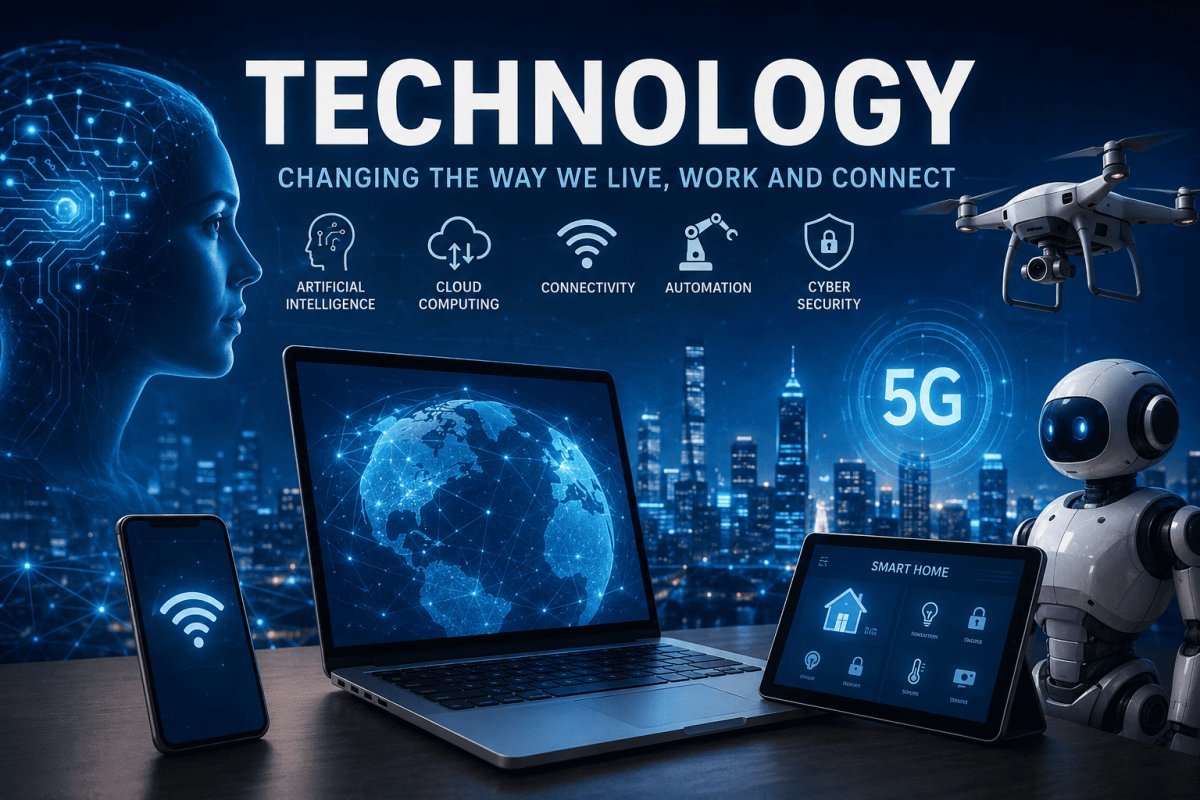
Technology has become such a normal part of our lives that it is easy to forget how quickly things have changed. A few decades ago, having a computer at home was considered a luxury. Today, most people carry a powerful computer in their pocket every day.
From smartphones and artificial intelligence to cloud computing and smart devices, technology is changing the way we communicate, work, shop, learn, and even relax. It has made many everyday tasks faster and easier, while also creating new challenges that society is still learning how to handle.
What Is Technology?
Technology refers to the tools, machines, systems, and processes people create to solve problems and make life easier. It includes everything from simple tools to advanced technologies such as artificial intelligence, robotics, cloud computing, and the internet.
Technology is not limited to computers and smartphones. Cars, medical equipment, home appliances, payment systems, and modern farming machinery are all examples of technology that play an important role in everyday life.
The main purpose of technology has always been fairly simple: to help people do things better, faster, and more efficiently.
The Importance of Technology in Everyday Life
It is difficult to imagine modern life without technology. We use it from the moment we wake up until we go to sleep.
Smartphones allow us to communicate with family and friends within seconds. Online banking lets people manage their finances without visiting a bank. GPS applications help us find unfamiliar places, while streaming platforms give us access to movies, music, and entertainment whenever we want.
Even simple household activities have become more convenient because of technology. Smart appliances, online shopping, digital payments, and home security systems are changing the way people manage their homes.
In many ways, technology has become less about owning impressive gadgets and more about making everyday life convenient.
Technology in the Workplace
The workplace has changed dramatically because of technology. Businesses can now communicate with customers and employees across the world without needing everyone to be in the same building.
Video conferencing, project management software, cloud storage, and instant messaging have made remote and hybrid work possible for millions of people.
Technology has also reduced the amount of time employees spend on repetitive tasks. Businesses can use software to organize data, manage inventory, process payments, and handle customer inquiries.
At the same time, workers need to keep learning. New software and digital tools appear regularly, which means skills that were valuable a few years ago may not be enough today.
The Rise of Artificial Intelligence
Artificial intelligence, commonly known as AI, has become one of the biggest technology trends in recent years.
AI systems can analyze large amounts of information, recognize patterns, generate content, translate languages, and assist with many different tasks. Businesses are using AI for customer support, data analysis, marketing, software development, and other areas.
However, AI is not simply about replacing people. In many situations, its real value comes from helping people work more efficiently. A designer can use AI to explore ideas, a researcher can use it to organize information, and a business owner can use AI tools to automate routine work.
The important question is no longer whether AI will become part of everyday life. It already is. The bigger question is how people and businesses will use it responsibly.
Technology and Education
Education has also benefited from technological development. Students no longer have to rely only on textbooks or classroom lectures to learn something new.
Online courses, educational videos, digital libraries, interactive applications, and virtual classrooms have made learning more accessible.
A student living in a small town can take an online course from an institution located thousands of miles away. Someone trying to learn a new skill can watch tutorials, practice online, and find communities of people with similar interests.
Technology does not replace good teachers, but it gives teachers and students more tools to make learning engaging and flexible.
The Impact of Technology on Communication
Communication may be one of the areas most affected by technology.
In the past, sending a message to someone in another country could take days or even weeks. Today, a WhatsApp message, email, video call, or social media post can reach someone almost instantly.
This has made the world feel smaller. Families can stay connected across countries, companies can work with international teams, and people can build friendships with others they may never meet in person.
But there is another side to this convenience. Constant notifications and social media can make people feel overwhelmed. Spending too much time online can also reduce face-to-face interaction.
Technology itself is not necessarily the problem. The way we use it matters.
Technology in Healthcare
Modern healthcare depends heavily on technology. Doctors use advanced equipment to diagnose diseases, monitor patients, and perform complicated procedures.
Digital medical records make it easier for healthcare professionals to access important patient information. Telemedicine also allows patients to communicate with healthcare providers remotely, which can be especially useful for people who live far from hospitals and clinics.
Wearable devices are another growing area. Smartwatches and fitness trackers can monitor things such as heart rate, activity, and sleep patterns.
As technology continues to improve, healthcare could become more personalized, efficient, and accessible.
The Advantages of Technology
There are many reasons technology has become so important.
Some of the biggest advantages include:
- Faster communication
- Easier access to information
- Increased workplace productivity
- Improved healthcare services
- More flexible education
- Convenient online shopping and banking
- Better transportation and navigation
- Automation of repetitive tasks
- New business and career opportunities
Technology has also created entire industries that did not exist in the same form a generation ago. Software development, cybersecurity, digital marketing, cloud computing, and many other fields now provide employment for millions of people.
The Disadvantages of Technology
Despite its benefits, technology also has drawbacks.
Privacy is a major concern. People share enormous amounts of information online, and companies collect data about how their products and services are used.
Cybersecurity is another important issue. Hackers and online criminals continue to find new ways to target individuals and organizations.
There are also concerns about excessive screen time, social media addiction, misinformation, job displacement through automation, and the environmental impact of electronic devices.
These challenges do not mean we should reject technology. Instead, they show why responsible use and better digital awareness are becoming increasingly important.
What Does the Future of Technology Look Like?
The future of technology is difficult to predict, but one thing is certain: change will continue.
Artificial intelligence, robotics, renewable energy, biotechnology, smart homes, electric vehicles, and advanced computing are likely to play increasingly important roles in the coming years.
Some technologies that seem unusual today may eventually become ordinary parts of daily life.
The most important skill may not be knowing exactly which technology will become popular next. It may be the ability to adapt when change happens.
Final Thoughts
Technology has transformed modern life in ways that would have been difficult to imagine only a few decades ago. It helps us communicate, work, learn, travel, manage our health, and solve everyday problems.
But technology is only a tool. Its impact depends on how people choose to develop and use it.
The goal should not be to use technology simply because something new exists. The better approach is to use technology where it genuinely improves people's lives while remaining aware of its risks.
As technology continues to evolve, staying curious, learning new skills, and using digital tools responsibly will become increasingly important.
About M. Nafees

Comments
Comments (0)
Security Check
Please complete the captcha to verify you are human.