
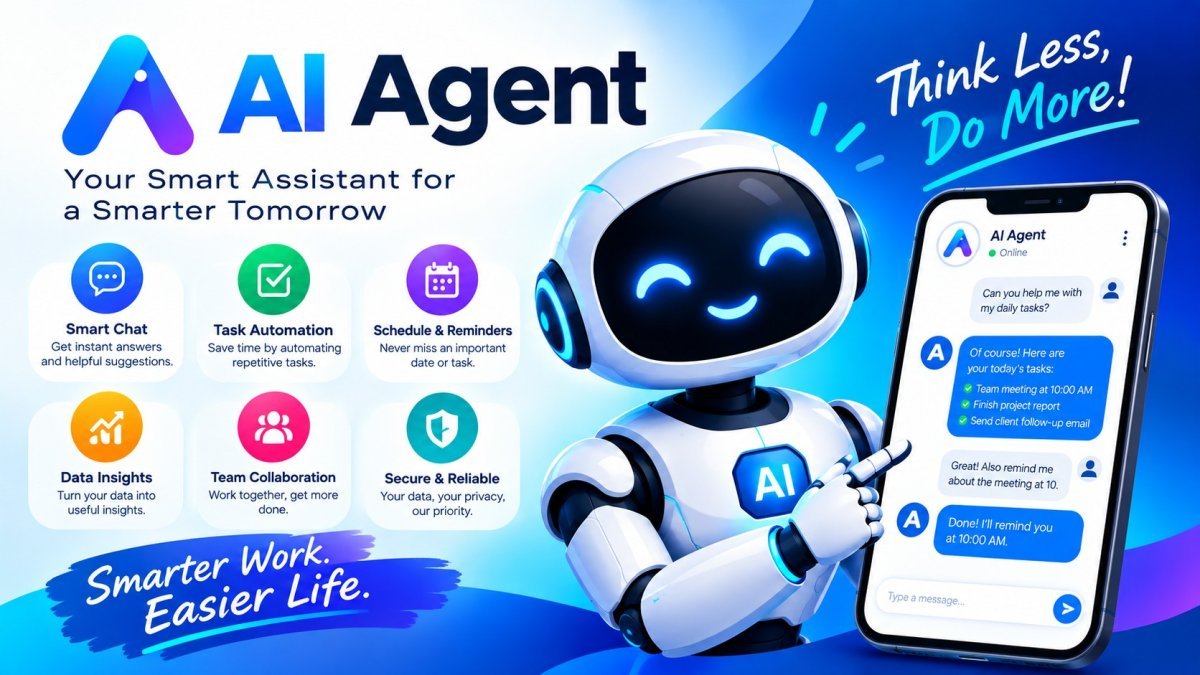
Artificial intelligence is moving beyond simple chatbots and content-generation tools. Today, an AI agent can understand a goal, make decisions, use digital tools, and complete a series of tasks with limited human intervention.
From handling customer questions to analyzing data and managing repetitive workflows, AI agents are becoming an important part of modern business technology. As the technology develops, companies are exploring new ways to use AI agents to save time, improve productivity, and create better customer experiences.
But what exactly is an AI agent, and how does it work?
What Is an AI Agent?
An AI agent is a software system that can perceive information, reason about what needs to be done, and take actions to achieve a specific goal.
Unlike a traditional chatbot that mainly responds to individual prompts, an AI agent can often work through multiple steps. For example, if you ask an AI agent to research potential customers, it may collect information, organize the data, analyze it, and prepare a report.
The basic process usually looks like this:
Understand the goal → Plan the task → Use available tools → Take action → Check the result
This ability to work through a process is one reason AI agents are attracting so much attention.
How Does an AI Agent Work?
An AI agent typically combines several technologies to complete a task.
1. Understanding the request
The agent first interprets the user's instructions or business objective. Modern language models can help the system understand natural language and determine what the user wants.
2. Planning
After understanding the objective, the agent can break a complicated task into smaller steps. This allows it to approach problems systematically rather than simply producing one response.
3. Using tools
An AI agent can be connected to tools such as databases, websites, calendars, business software, APIs, and other applications. These connections allow the agent to do more than generate text.
4. Taking action
Depending on its permissions, the agent may send an email, update a record, create a report, search for information, or perform another digital task.
5. Reviewing the result
Some systems can evaluate the outcome and make adjustments when necessary. This feedback loop can make agents more useful for tasks that involve multiple stages.
What Is AI Agent Automation?
AI agent automation refers to using AI agents to perform workflows that would traditionally require people to complete manually.
For example, a business could use an AI agent to process incoming customer inquiries. The agent could understand the customer's question, find relevant information, prepare a response, and route complicated issues to a human employee.
This is different from basic automation because the workflow can involve interpretation and decision-making rather than following only fixed rules.
Common examples include:
-
Customer support automation
-
Lead qualification
-
Email and document processing
-
Data analysis
-
Appointment scheduling
-
Research and reporting
-
Internal knowledge management
-
Software development assistance
The goal isn't necessarily to remove humans from a process. In many cases, the more practical approach is to let AI handle repetitive work while employees focus on tasks requiring judgment, creativity, and personal interaction.
What Is an Autonomous AI Agent?
An autonomous AI agent is designed to operate with a greater degree of independence.
Instead of requiring a person to provide instructions for every individual step, an autonomous agent can receive a broader objective and determine the actions needed to accomplish it.
For example, imagine a marketing team wants to monitor competitors. An autonomous AI agent could be configured to regularly gather publicly available information, organize relevant changes, summarize them, and produce a report for the team.
However, autonomy needs appropriate controls. Businesses should consider permissions, data security, monitoring, and human approval for important actions.
An agent that can make decisions and take actions independently needs stronger safeguards than a system that only provides suggestions.
AI Agent Technology Explained
AI agent technology brings together several areas of artificial intelligence and software engineering.
Large language models are often used as the reasoning or language layer, while other technologies provide memory, tool access, data retrieval, workflow management, and security.
Some important components include:
-
Large language models: Help agents understand instructions and generate responses.
-
Tool integration: Allows agents to interact with software, APIs, databases, and other systems.
-
Memory: Helps an agent retain relevant information during or across tasks.
-
Retrieval systems: Allow agents to access information from approved documents or databases.
-
Planning: Helps break complex objectives into manageable actions.
-
Monitoring: Tracks what the agent is doing and helps identify errors.
-
Security controls: Limit what an agent is allowed to access or change.
Together, these technologies can turn a language model into a system capable of completing more complex workflows.
AI Agent for Business: Practical Use Cases
The potential of an AI agent for business is particularly significant because many organizations have repetitive digital processes.
Customer service
AI agents can answer common questions, retrieve information, and help customers navigate basic support processes. More complex cases can be transferred to human representatives.
Sales
Agents can help research prospects, organize customer information, summarize conversations, and assist sales teams with follow-up activities.
Marketing
Marketing teams can use agents for research, content planning, campaign analysis, and reporting.
Human resources
AI agents can help employees find information about company policies, benefits, procedures, and other internal resources.
Finance
Agents can assist with tasks such as document processing, financial data analysis, and generating routine reports, subject to appropriate controls and review.
Software development
AI agents can assist developers with researching documentation, writing code, debugging, testing, and managing repetitive development tasks.
Benefits of AI Agents
AI agents can provide several potential advantages when they are implemented appropriately.
Higher productivity: Agents can handle repetitive digital tasks, giving employees more time for higher-value work.
Faster workflows: An agent can potentially complete several connected steps without requiring a person to manually move information between applications.
24/7 availability: Digital agents can operate outside traditional working hours.
Scalability: Businesses can deploy software-based agents across large volumes of routine tasks.
Better access to information: Agents can help employees find and summarize information from approved sources.
Challenges and Limitations
AI agents are not perfect. They can misunderstand instructions, produce incorrect information, make inappropriate decisions, or encounter unexpected situations.
Businesses should therefore think carefully about:
-
Data privacy
-
Cybersecurity
-
Accuracy
-
Access permissions
-
Human oversight
-
Cost of AI infrastructure
-
Integration with existing software
-
Monitoring and auditing
For high-impact decisions, human review can remain especially important.
The most effective approach is often not simply giving an AI agent complete control. Instead, organizations can define what the agent is allowed to do, what requires approval, and when a task must be handed to a person.
The Future of AI Agents
AI agents are likely to become increasingly connected to the software and services people use every day.
Instead of opening several applications and completing every step manually, a user may eventually be able to describe a goal and have an agent coordinate the required tools.
For businesses, this could mean moving from isolated AI features toward complete AI-assisted workflows.
The technology is still developing, and its long-term impact will depend on improvements in reliability, security, cost, and integration. Companies that adopt agents will need to balance automation with appropriate human oversight.
Final Thoughts
An AI agent is more than a chatbot. It is an AI-powered system designed to understand goals, reason through tasks, use tools, and take actions.
With AI agent automation, businesses can streamline repetitive workflows. An autonomous AI agent can work with greater independence, while advances in AI agent technology are making these systems more capable and flexible.
For organizations considering an AI agent for business, the best starting point is usually a clearly defined, repetitive workflow where the potential benefits can be measured. With the right controls and human oversight, AI agents can become useful assistants rather than simply another piece of software.
Frequently Asked Questions About AI Agents
What is an AI agent?
An AI agent is a software system that can understand a goal, make decisions, use tools, and perform actions to accomplish a task.
How are AI agents different from chatbots?
A chatbot generally focuses on responding to user messages. An AI agent can go further by planning multiple steps, interacting with external tools, and completing tasks.
Can AI agents automate business tasks?
Yes. AI agents can be used for tasks such as customer support, research, data processing, sales assistance, reporting, and workflow management.
Are autonomous AI agents completely independent?
Not necessarily. The level of autonomy depends on how the system is designed and what permissions it receives. Important workflows can include human approval and monitoring.
Is AI agent technology useful for small businesses?
It can be useful when a business has repetitive digital tasks that consume significant employee time. Starting with a narrow, measurable workflow can make adoption easier.

Comments
Comments (0)
Security Check
Please complete the captcha to verify you are human.